Read a little. Learn a lot. • Now Mullenweg-free! • Since 2009
☰

Tag: washington post

73 posts

Oct 6 2011t

Editor’s note

Editor’s note: I likely work at the only newspaper in the country which had to yell “stop the presses” in response to Steve Jobs’ death. That’s because our deadline is an insanely early 7 p.m. We were running a little late tonight. At 7:37, I got Matt’s e-mail about Jobs’ death. People came running back in to get something in the paper about him. We couldn’t pull off a cover, but we redid a page. We got out at roughly 8:20. Tonight was rough. And sad. I’m still pretty numb about this whole thing. Steve will be missed. Greatly. — Ernie @ SFB

Posted by ShortFormBlog • Permalink

Sep 24 2011t

We want to see Jack

imwithkanye:

I’ll let Jack explain

“Perhaps it will impress on you how sluggishly your pages load to learn that pornography sites download much faster than washing­tonpost.com does! Trust me on this. And those sites’ pages are much more ‘content dense’ and have significantly more ‘dynamic’ content and ads than washingtonpost.com, with very little simple text (obviously!). . . .

“By contrast, your site subjects me to a tedious, lumbering stream of browser ‘Waiting for [various] plug-in’ messages and download-progress bars. Meanwhile, my screen remains frozen, so I can’t even scroll through the content that has already downloaded. This seldom happens on the porn sites I frequent.”

We want to see Jack do a side-by-side comparison in a video.

Posted by ShortFormBlog • Permalink

Sep 23 2011t

So, we kept a little mum

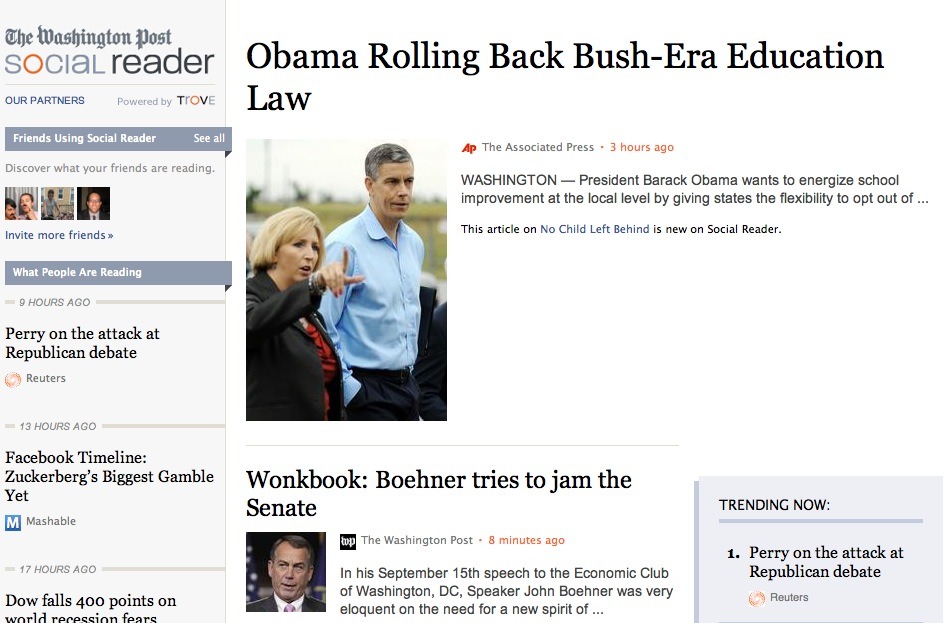
So, we kept a little mum on yesterday’s big changes with Facebook, in part because our day was extra-packed, but we gotta say … wow, that seems to have lived up to the hype. (We were skeptical the night before, esp. after Ben Parr’s fawning article on Mashable) The new Timeline feature will take some getting used to, but the big difference this time is that Facebook isn’t just pushing pixels around (which seemed like the modus operandi for most of their redesigns) but actually reinventing things. And, as a Washington Post Company employee when not blogging here, I just gotta say … wow. The Social Reader, built from Trove’s humble beginnings, is easily the best piece of software the Post has ever created. Seriously, you should check it out. — Ernie @ SFB

Posted by ShortFormBlog • Permalink

Sep 9 2011t

The crazy part about this

imwithkanye:

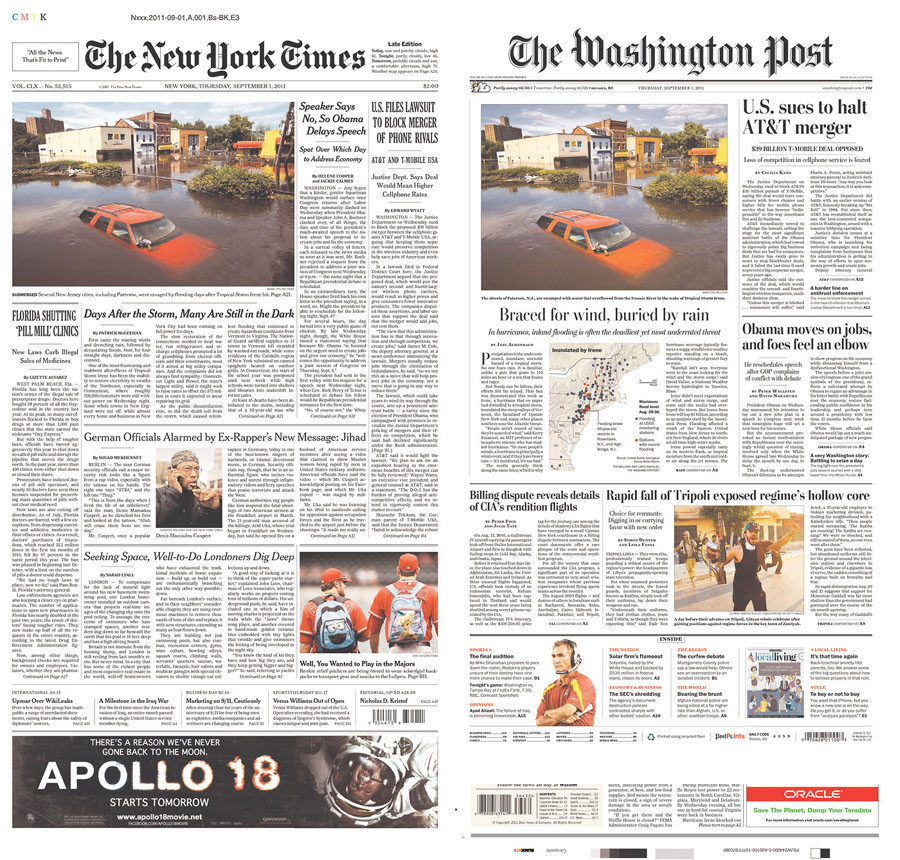
An amazing collection of photos from the Washington Post depicting the floods in the Washington DC area. Here tips of cars can be seen in the flooded North Reston Park and Ride Lot in Fairfax, Va.

The crazy part about this is that other parts of the region are relatively dry, such as the part that we’re currently sitting in. Good find.

Posted by ShortFormBlog • Permalink

May 17 2011W

Tech: Washington Post disputes Pew's findings on Drudge influence

  • Washington Post cries foul on pew study: You may recall this research report by Pew, which claimed that Drudge Report (which, content aside, looks a lot like a Geocities page we made for a middle school project in the mid-90s) drove 15% of the Washington Post's online traffic. David Carr even wrote a piece on the thing which feted Drudge. The folks at WaPo have responded, calling the report inaccurate and citing their own numbers, which credit 2.5% of their total traffic to Drudge. Pew used Nielsen data from three months in 2010, but three different companies working for WaPo failed to measure a percentage that cracked double digits over the same three months. source

Posted by Chris Tognotti • Permalink

Tags for this post

May 12 2011t
May 3 2011W

Biz: Newspaper pulse check: Why one paper's circulation skyrocketed

  • The newspaper is doing OK right now. Not great, just OK. In the past six months, that gray newsprint behemoth did OK, according to the Audit Bureau of Circulation, with the top two papers gaining some ground and most of the top five staying roughly in the same order. However, the way that the group analyzed the data changed this time around — deciding, instead of focusing just on paid circulation, to emphasize "average circulation," which includes separate editions under the umbrella of a certain brand. The numbers caused one paper to rocket into the top five and one to fall out. See if you can guess by the numbers below:
  • 2.1 million daily circulation for the top-ranked Wall Street Journal
  • 1.8 million average daily circulation for the still-second-place USA Today
  • 916,911 average daily circulation for the freshly-paywalled New York Times
  • 605k average daily circulation for the Los Angeles Times
  • 577k average daily circulation for the San Jose Mercury News
  • 550k average daily circulation for the Washington Post source
  • » A few things of note: If you guessed that the San Jose Mercury News benefited greatly from the change in data, you're correct — MediaNews treats each newspaper on this page as an "edition" of the Mercury News (which seems a little number-inflating). Other notes: This data covers the daily circulation for the past six months — a period which only includes a tiny bit of the New York Times' post-paywall circulation (so come back in six months to see if it was a success). But e-editions are doing quite well, especially for the Wall Street Journal and Detroit Free Press. One last thing: The numbers only cover paid newspapers, not free ones. (photo by Brent D. Payne)

Posted by Ernie Smith • Permalink

Apr 10 2011t

Fun fact about the Washington Post Co.: Its fastest-growing profit driver isn't newspapers, magazines or Web…

And in case you were wondering, the government hasn’t exactly been kind to the concept, claiming that students are dropping out of the company’s Kaplan Higher Education, aren’t getting what they paid for, and default on their loans. How did a newspaper company get involved in this mess? Read on.

Posted by ShortFormBlog • Permalink

Mar 9 2011W

U.S.: Washington Post political reporter David S. Broder has died

  • David S. Broder, dead at 81: The legendary Washington Post political reporter passed away today. A veteran of cataclysmic American news stories, not least of all the Watergate scandal, Broder was a deeply respected and revered figure in print news, and had last contributed a column to the Post on February 6th. I think most everybody understands the dream of loving your work so much that you want to just keep doing it, even into your 80s. That Broder knew this joy, and showed this industriousness, is a credit both to himself and the people who surrounded him. source

Posted by Chris Tognotti • Permalink