Read a little. Learn a lot. • Now Mullenweg-free! • Since 2009
☰

Tag: wall street journal

44 posts

Jan 19 2012t

The Wall Street Journal's pro-SOPA editorial must've come from Rupert Murdoch's own pen. It's just … wow.

The tech industry says it wants to stop such crimes, but it also calls any tangible effort to do so censorship that would “break the Internet.” Wikipedia has never blacked itself out before on any other political issue, nor have websites like Mozilla or the social news aggregator Reddit. How’s that for irony: Companies supposedly devoted to the free flow of information are gagging themselves, and the only practical effect will be to enable fraudsters. They’ve taken no comparable action against, say, Chinese repression.

Now, let’s take a step back here. Let’s go back to the prior post we put up. Are we gonna have to throw out some motha@*&!in Clay Shirky on ya? The problem is not the law as written. It’s the burden of proof. Basically, you’re going to put any mom-and-pop startup in a position where they have to monitor every single transaction that goes through their site to ensure it doesn’t link to an illegal foreign site. And to twist the issue to make them look like hypocrites for not taking political stances on other things? Come on. This directly affects their bottom line. It weighs them down in bureaucracy. If Steve Jobs and Steve Wozniak had to work around barriers like this, they probably would’ve stuck with phone phreaking. The problem here is not the explicit solution; it’s the consequences and side effects.

The Wall Street Journal is a great newspaper saddled by an editorial page written by a bunch of people who haven’t been outside of their bubbles in the past 20 years, buoyed by a subscriber base unlike any other in newspapers, and influenced by one of the more obsessive minds in the business industry. And here’s this board, scolding a sector that bothered to defend itself against a lobbying prowess the best way they know how — through word-of-mouth. These sites that went down today should be lauded for not letting themselves get bullied. Yes, the people who wrote this article? They’re bullies, shouting off in the distance, far away from the crowds.

This is a travesty of an editorial; it damages the reputation of one of the greats.

Posted by ShortFormBlog • Permalink

Oct 6 2011t

Walt Mossberg had perhaps

Embedded media from s.wsj.net is no longer available.

Walt Mossberg had perhaps the closest relationship with Steve Jobs amongst journalists. Here’s his take on Jobs’ passing — about a post-surgery meeting he had with Jobs, and a walk they took despite Jobs’ clear illness. Jobs really wanted to go. “That’s not a story I would have told before now,” Mossberg said, “ but I think it says a little bit about the way he sets goals and goes after them.”

Posted by ShortFormBlog • Permalink

May 3 2011W

Biz: Newspaper pulse check: Why one paper's circulation skyrocketed

  • The newspaper is doing OK right now. Not great, just OK. In the past six months, that gray newsprint behemoth did OK, according to the Audit Bureau of Circulation, with the top two papers gaining some ground and most of the top five staying roughly in the same order. However, the way that the group analyzed the data changed this time around — deciding, instead of focusing just on paid circulation, to emphasize "average circulation," which includes separate editions under the umbrella of a certain brand. The numbers caused one paper to rocket into the top five and one to fall out. See if you can guess by the numbers below:
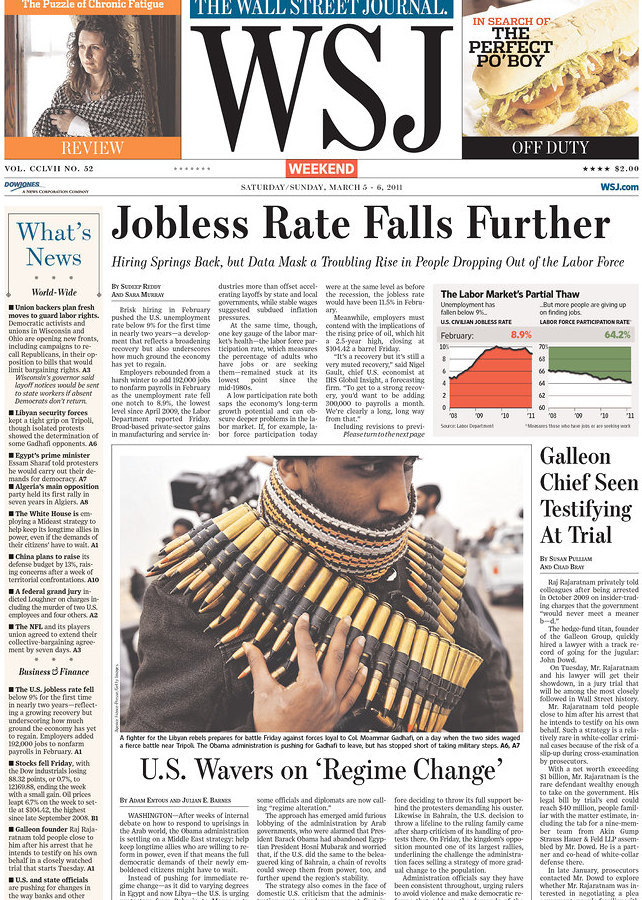
  • 2.1 million daily circulation for the top-ranked Wall Street Journal
  • 1.8 million average daily circulation for the still-second-place USA Today
  • 916,911 average daily circulation for the freshly-paywalled New York Times
  • 605k average daily circulation for the Los Angeles Times
  • 577k average daily circulation for the San Jose Mercury News
  • 550k average daily circulation for the Washington Post source
  • » A few things of note: If you guessed that the San Jose Mercury News benefited greatly from the change in data, you're correct — MediaNews treats each newspaper on this page as an "edition" of the Mercury News (which seems a little number-inflating). Other notes: This data covers the daily circulation for the past six months — a period which only includes a tiny bit of the New York Times' post-paywall circulation (so come back in six months to see if it was a success). But e-editions are doing quite well, especially for the Wall Street Journal and Detroit Free Press. One last thing: The numbers only cover paid newspapers, not free ones. (photo by Brent D. Payne)

Posted by Ernie Smith • Permalink