ShortFormBlog
Via shortformblog:
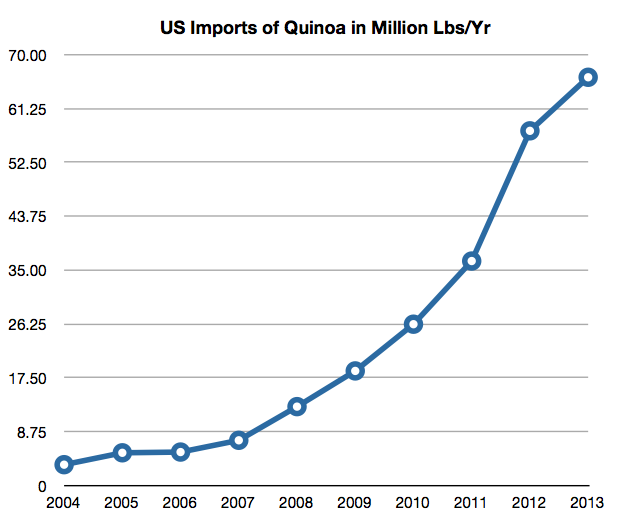
cutlerish said: Also, quinoa is a staple food in a lot of poorer areas that now have to deal with first-world demand driving costs up.
» SFB says: This is a definite thing that’s floated around in recent months for good reason, but the Wonkblog post we linked to makes a good…
I specialize on Bolivian politics, so this is something that I’m more familiar and/or interested in. But it’s also a great example of the complexities of development (costs go up, but so do standards of living). But in particular of the danger of relying on “comparative advantage" in a global marketplace.
Let’s face it, quinoa can probably be grown better, faster, more efficiently, etc. in many other parts of the world simply because Andean highland farmers are very poor. Sure, they have a comparative advantage now. But in reality, they have a comparative disadvantage relative to countries with mass-scale agribusiness. It’s why a number of native Andean or Meso-American crops (potatoes, corn, tomatoes) are now primarily associated with other places (Idaho, Iowa, California).
We’ve watched interest rise and fall in a number of “ancient" or traditional specialty crops in the past half century including amaranth and teff as well as quinoa. To date, only quinoa has shown signs of moving to a broadly accepted foodstuff. Great chance for some young ag economists or developmental economists to follow - and project - what this means. Like Pol 102 I worry about the impact on traditional near-subsistence agricultural when the crop is commodified and production translated elsewhere. I also worry about what happens when the quinoa trend runs its course. What can we learn from the experience of other 20th century food introductions? What from even older ones? Where and how do earlier models differ from the quinoa experience? And when the study is ready to go, lets see it published in the Real-World Economics Review.
Reblogging for the great commentary drawn by both Meadow’s Lark and Miguel Centellas. This is a good conversation to have.