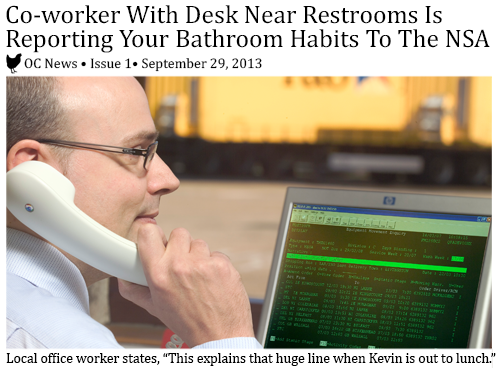

Leaked data reveals co-worker reporting frequency and duration of your bathroom trips to the NSA
Okay, we can take a minute and laugh.
 ShortFormBlogRead a little. Learn a lot. • Now Mullenweg-free! • Since 2009
110 posts
Leaked data reveals co-worker reporting frequency and duration of your bathroom trips to the NSA
Okay, we can take a minute and laugh.
Posted by Patrick deHahn • Permalink
Why isn’t there a public outcry by the American people against a government which betrayed them? How can they live with their lives being infiltrated and spied upon by an agency caught in it’s own lies? Why aren’t the members of Government and the NSA involved being sued for privacy issue and data infringement along with international espionage plus the trafficking of data involving matters of national security to another sovereign nation. The Agency breaks international laws and breaks all code of ethics yet still they are able to justify it. This just shows how weak the American people really are standing by while their government takes away their civil rights and all meaning from the amendments.
— A commenter says on The Guardian’s new NSA/Snowden revelation hub.
Posted by Patrick deHahn • Permalink
Since 2010 the National Security Agency has been exploiting its huge collections of data to create sophisticated graphs of some Americans’ social connections that can identify their associates, their locations at certain times, their traveling companions and other personal information, according to newly disclosed documents and interviews with officials. The agency was authorized to conduct “large-scale graph analysis on very large sets of communications metadata without having to check foreignness” of every e-mail address, phone number or other identifier, the document said. Because of concerns about infringing on the privacy of American citizens, the computer analysis of such data had previously been permitted only for foreigners.
The agency can augment the communications data with material from public, commercial and other sources, including bank codes, insurance information, Facebook profiles, passenger manifests, voter registration rolls and GPS location information, as well as property records and unspecified tax data, according to the documents. They do not indicate any restrictions on the use of such “enrichment” data, and several former senior Obama administration officials said the agency drew on it for both Americans and foreigners.
This is merely old information, rehashed with new and official information through more revelations reported by the NYTimes. It’s essentially to wake people up - we all use social networks - and to show how the government and the NSA collects our information that we share on social media, creating extensive maps and graphs.
Posted by Patrick deHahn • Permalink
Two American journalists known for their investigations of the United States’ government said Saturday they’ve teamed up to report on the National Security Agency’s role in what one called a “U.S. assassination program.” Jeremy Scahill, a contributor to The Nation magazine and the New York Times best-selling author of “Dirty Wars,” said he will be working with Glenn Greenwald, the Rio-based journalist who has written stories about U.S. surveillance programs based on documents leaked by former NSA contractor Edward Snowden.
“The connections between war and surveillance are clear. I don’t want to give too much away but Glenn and I are working on a project right now that has at its center how the National Security Agency plays a significant, central role in the U.S. assassination program,” said Scahill, speaking to moviegoers in Rio de Janeiro, where the documentary based on his book made its Latin American debut at the Rio Film Festival.
“There are so many stories that are yet to be published that we hope will produce ‘actionable intelligence,’ or information that ordinary citizens across the world can use to try to fight for change, to try to confront those in power,” said Scahill.
This is huge. It’s really going to shake things up. And especially, I love Scahill’s work (am currently reading “Dirty Wars,” definitely give it a read) and have grown to appreciate Greenwald’s work. Love them or not, this is something to watch.
Posted by Patrick deHahn • Permalink
We need our nation to understand why we need these tools…If you take those [surveillance powers] away, think about the last week and what will happen in the future. If you think it’s bad now, wait until you get some of those things that happened in Nairobi.
— Keith Alexander, Director of the National Security Agency - Defending the NSA’s surveillance activities, while also asking the public to stop pursuing legal means of ending the programs, during a speech on Wednesday, Alexander spoke at a cybersecurity summit hosted by he National Press Club just hours before he and other high-ranking intelligence officials are expected to testify during a classified House Judiciary Committee hearing. The NSA director is also expected to offer testimony during a Senate hearing on Thursday. source
Posted by Scott Craft • Permalink
An understandable mistake, especially if English isn’t your first language. It also bears mentioning that NASA’s website is notoriously easy to hack, so there’s the possibility this wasn’t a mistake at all, but simply the hitting of an easy target. NASA officials say no sensitive data was compromised. source
Posted by Seth Millstein • Permalink
The president has said that he understands and regrets the concerns that disclosures of alleged U.S. intelligence activities have generated in Brazil and made clear that he is committed to working together with President Rousseff and her government in diplomatic channels to move beyond this issue as a source of tension in our bilateral relationship.
— A White House statement • Responding to the postponement of a state visit (a rare occurrence in diplomatic circles) from Brazilian President Dilma Rousseff. Rousseff won’t be attending the planned-upon meeting in late October, as a result of revelations (owed to leaks from former NSA-er Edward Snowden) of spying by the NSA against herself, aides, and the oil company Petrobus, the largest of any type of company in Brazil. President Obama reportedly spoke to Rousseff on Monday night to urge her to make the visit, but the effort proved fruitless. The White House has since stated that both Obama and Rousseff agreed to the postponement. source
Posted by Chris Tognotti • Permalink
When you lose and you don’t comply, it’s treason. We think it makes more sense to work within the system.
— Yahoo CEO Marissa Mayer • Offering a pretty open-and-shut answer, when asked why Yahoo and other companies hadn’t simply disclosed the NSA’s surveillance activities sooner, during TechCrunch’s annual Disrupt conference in San Francisco. A number of top tech executives were asked about the NSA during Disrupt this week, including Facebook CEO Mark Zuckerberg, who said he felt like the government’s response to the Snowden leaks wasn’t any more helpful than their decision to force silence on companies like Yahoo and Facebook in the first place. source
Posted by Scott Craft • Permalink
The National Security Agency routinely shares raw intelligence data with Israel without first sifting it to remove information about US citizens, a top-secret document provided to the Guardian by whistleblower Edward Snowden reveals.
Details of the intelligence-sharing agreement are laid out in a memorandum of understanding between the NSA and its Israeli counterpart that shows the US government handed over intercepted communications likely to contain phone calls and emails of American citizens. The agreement places no legally binding limits on the use of the data by the Israelis.
The disclosure that the NSA agreed to provide raw intelligence data to a foreign country contrasts with assurances from the Obama administration that there are rigorous safeguards to protect the privacy of US citizens caught in the dragnet. The intelligence community calls this process “minimization”, but the memorandum makes clear that the information shared with the Israelis would be in its pre-minimized state.
Posted by Scott Craft • Permalink
By: Ron Bell, General Counsel
Yahoo filed suit in the Foreign Intelligence Surveillance Court (FISC) this morning demanding the right to publicly disclose the number of user data requests that we receive from the U.S. Government under national security statutes. This latest effort to fight for our users follows the release of our first transparency report last week, as well as a series of legal actions we’ve taken in the FISC urging the U.S. Government to make additional information available to the public.
The numbers we shared within our transparency report for the United States include all types of government data requests, such as criminal law enforcement requests and those under U.S. national security authorities, including the Foreign Intelligence Surveillance Act (FISA) and National Security Letters (NSLs), if any were received.
We filed the suit today because we are not authorized at present to break out the number of requests, if any, that we receive for user data under specific national security statutes. The U.S. Government prohibits companies from disclosing this information.
We believe that the U.S. Government’s important responsibility to protect public safety can be carried out without precluding Internet companies from sharing the number of national security requests they may receive. Ultimately, withholding such information breeds mistrust and suspicion—both of the United States and of companies that must comply with government legal directives.
Later today we will participate in President Obama’s Review Group on Intelligence and Communications Technology where we’ll have the opportunity to connect directly around issues at the intersection of national security and technology, including transparency.
The United States should lead the world when it comes to transparency, accountability, and respect of civil liberties and human rights. The U.S. Government’s recent decision to release aggregate annual data about its requests for phone call logs and Internet chats was an important first step in this direction. Granting our petition for greater transparency around national security requests for user data is a critical second step.
This makes up for the logo.
Posted by Ernie Smith • Permalink