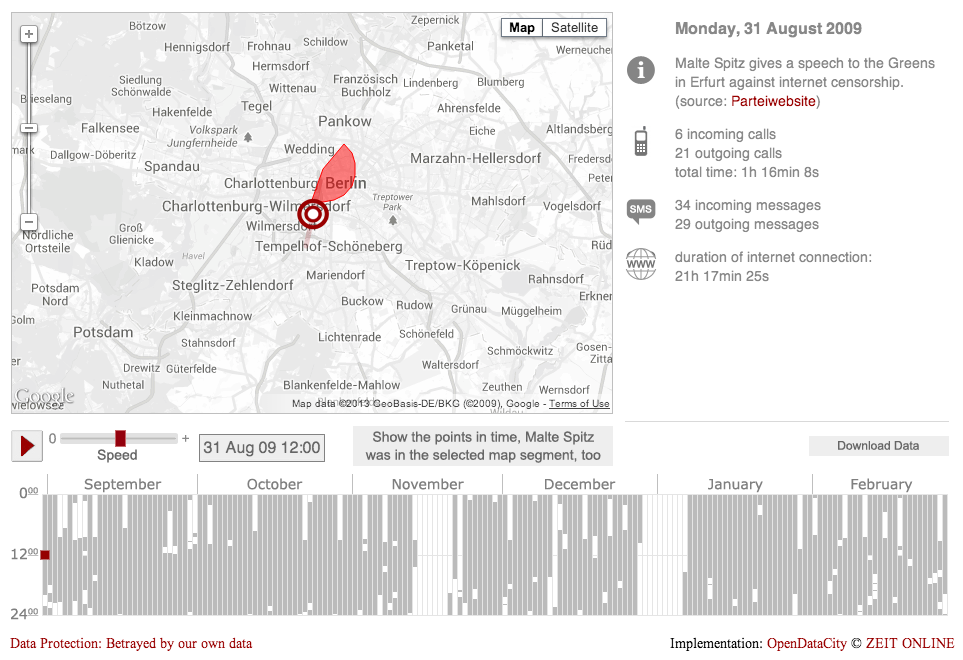
While some are claiming that the situation involving metadata that phone companies are being forced to hand over to the NSA isn’t really as bad as it seems, the truth is, when combined with other information, that metadata can say a ton. Here’s an example in the form of an interactive graphic the German newspaper Die Zeit made of a Green Party politician, Malte Spitz, who sued his phone company to release his data to the newspaper. Die Zeit used the metadata gathered and combined it with publicly available information about Spitz. The results? Well … just click the link and hit play. (thanks Jessica Binsch)
Tag: national security agency
67 posts
According to this document
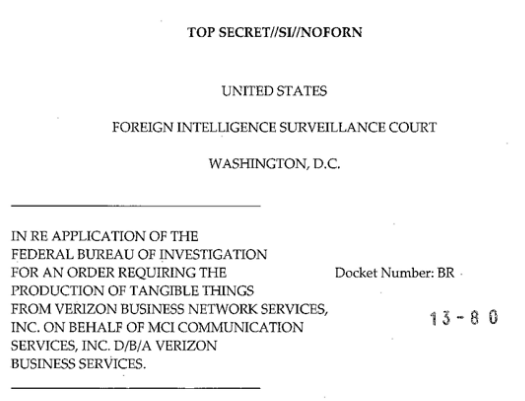
According to this document obtained by The Guardian, the federal government, through a court order granted to the National Security Agency, is using the Patriot Act to collect the phone records of millions of Verizon users over a three-month period. Awesome. Read the full document here. It’s like the AP thing, except extended to everyone else.
Posted by Ernie Smith • Permalink
The court order doesn’t allow the NSA to collect any information whatsoever on the contents of phone calls…
The court order doesn’t allow the NSA to collect any information whatsoever on the contents of phone calls, or even to obtain any names or addresses of customers. What’s covered instead is known as “metadata”: the phone number of every caller and recipient; the unique serial number of the phones involved; the time and duration of each phone call; and potentially the location of each of the participants when the call happened. All of this information is being collected on millions of calls every day – every conversation taking place within the US, or between the US and a foreign country is collected.
— Telephone metadata and what it can tell the authorities about you | James Ball (via rubenfeld)
Big data, federal-style.
Posted by Ernie Smith • Permalink
Within the last few years, this program was used to stop a terrorist attack in the United States. We know…
Within the last few years, this program was used to stop a terrorist attack in the United States. We know that. It’s important. It fills in a little seam that we have, and it’s used to make sure that there is not an international [nexus] to any terrorism event if there may be one ongoing. So in that regard, it is a very valuable thing.
— Rep. Mike Rogers, House Intelligence Committee Chairman • Defending a recently revealed NSA program, which collected tens of millions phone records from Verizon, during a press conference on Thursday afternoon. Rep. Rogers claimed that the extremely unpopular program has already prevented at least one act of terrorism, but declined to divulge any additional details, saying such information is still in the process of being declassified. source
Posted by Scott Craft • Permalink
Washington Post: US mining data from 9 Internet firms in broad secret program
WashingtonPost: The National Security Agency and the FBI are tapping into the central servers of nine leading US Internet companies, extracting audio, video, photographs, e-mails, documents and connection logs that enable analysts to track a person’s movements and contacts over time.
The classified program, code-named PRISM, has not been disclosed publicly before Friday’s story in the Washington Post.
Its establishment in 2007 and six years of exponential growth took place beneath the surface of a roiling debate over the boundaries of surveillance and privacy.
More from the Post on the program here.
One of the companies is new Tumblr parent company Yahoo. Dropbox is reportedly next on the list.
Posted by Ernie Smith • Permalink
Appeals Court upholds U.S. government's right to perform warrantless wiretapping | Wired
The federal government may spy on Americans’ communications without warrants and without fear of being sued, a federal appeals court ruled Tuesday in a decision reversing the first and only case that successfully challenged President George W. Bush’s once-secret Terrorist Surveillance Program.
“This case effectively brings to an end the plaintiffs’ ongoing attempts to hold the executive branch responsible for intercepting telephone conversations without judicial authorization,” a three-judge panel of the 9th U.S. Circuit Court of Appealswrote. (.pdf)
The case concerned a lower court decision in which two American attorneys — who were working with the now-defunctal-Haramain Islamic Foundation— were awarded more than $20,000 each in damages and their lawyers $2.5 million in legal fees after a tortured legal battle where they proved they were spied on without warrants.
They sued under domestic spying laws Congress adopted in the wake of President Richard M. Nixon’s Watergate scandal. The government appealed their victory, and the appeals court Tuesday dismissed the suit and the damages.
A pretty major decision was handed down by the 9th Circuit today, but we’re betting that this isn’t going to be the last we’ll hear about this case.
Posted by ShortFormBlog • Permalink