Read a little. Learn a lot. • Now Mullenweg-free! • Since 2009
☰

Tag: mortgages

20 posts

Sep 14 2012t

It Is Now Cheaper to Own Than Rent

nprfreshair:

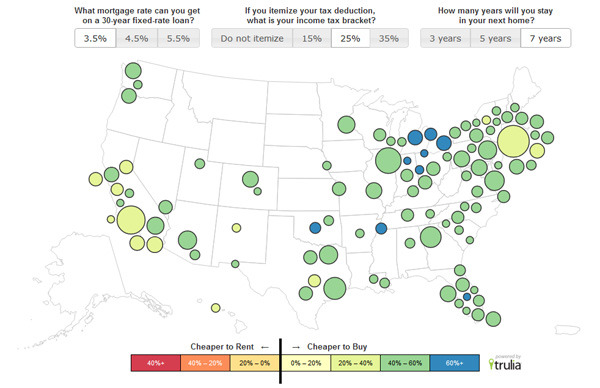
It Is Now Cheaper to Own Than Rent In Every Single One of America’s Largest Metros

There’s no doubt that home ownership is far more affordable today than it was before the bubble burst. Even so, it still makes sense to balance the short-run costs of owning versus renting with longer-run expected returns. Four of the five metros above — New York, San Francisco, San Jose, and L.A. — may be expensive because the market is pricing in predicted appreciation over the long-run. The reason prices are lower, and more affordable, in other metros likewise may be because the market expects lower rates of appreciation. There’s also the all-important question of ability to exit — whether and how quickly you can sell if you need to.

Read more. [Image: Trulia]

Do you rent or buy? Personally, we rent — but that’s because moving to a different city is a huge hassle if you own a home.
Posted by ShortFormBlog • Permalink

Mar 19 2012t

I may be poorer in my wallet, but psychologically I feel I have more.

I may be poorer in my wallet, but psychologically I feel I have more.

— 38-year-old Palestinian Ayman abu Hussein • Discussing how, despite the fact that he and his wife are both working and he has a second job, most of his family’s combined income — 60 percent — goes to paying back mortgages, loans and other kinds of debt, something which was rare in the West Bank until recently. Before, you needed three cosigners — or to be rich — to be able to get a mortgage. Now, upward mobility with the help of consumer debt is becoming more common. The region’s difficult political situation makes loans like this somewhat volatile, along with unique cultural factors — specifically, it’s difficult for lenders to repossess property in the region due to community pressure — but banks in the region are nonetheless moving forward. Fascinating.

Posted by ShortFormBlog • Permalink

Feb 9 2012W

Biz: Federal government, states agree to settle with mortgage industry

  • $26 billion "historic" settlement with the mortgage industry
  • $17B of that settlement is expected to help out more than 1 million homeowners — breaking that dow, that's an average of $17,000 each
  • 50 states could sign on as part of the settlement, making it the largest multistate settlement since the big tobacco deal in 1998
  • $2,000 the amount some homeowners who already lost their homes to foreclosure could get as part of the long-planned settlement source
  • » But is all this enough? While some will say the settlement doesn't go far enough in addressing the concerns homeowners have dealt with in the years since the housing bubble burst, officials suggest it could provide $40 billion in mortgage relief by reducing loan principals, which would make the dollars go further. Problem is, it's estimated that homeowners collectively owe $700 billion more on their homes than they're actually worth. So while the dollar number sounds high, it may only be a drop in the bucket comparatively.

Posted by Ernie Smith • Permalink

Dec 18 2011W

Politics: So … who's paying for the payroll tax cut, anyway? Homeowners

  • $17 per month charges on new homeowners' mortgages source
  • » Those who refinance will feel the pinch, too: To help pay for the $33 billion cost of the extended-by-two-months payroll tax cut, the federal government will increase the cost for homeowners to get their homes insured by Fannie Mae and Freddie Mac, who currently back nine out of ten home mortgages in the U.S. The fee, currently around 0.3 percentage points, would jump by 0.1 percentage points, which translates to roughly $17 per month for most homeowners. However, this fee would not affect current homeowners unless they refinance starting next year. Is this the best way to handle the extension?

Posted by Ernie Smith • Permalink

Dec 17 2011t

These material misstatements occurred during a time of acute investor interest in financial institutions’…

These material misstatements occurred during a time of acute investor interest in financial institutions’ exposure to subprime loans, and misled the market about the amount of risk on the company’s books.

— Securities and Exchange Commission enforcement division director Robert Khuzami • Discussing the civil fraud charges that the SEC filed against six former top execs at Fannie Mae and Freddie Mac, charges that came about due to alleged misrepresentation of investors’ exposure to the subprime mortgage crisis. Lawyers for the six officials claim that the executives acted in the best interests of investors despite the allegations otherwise.

Posted by ShortFormBlog • Permalink

Sep 2 2011t

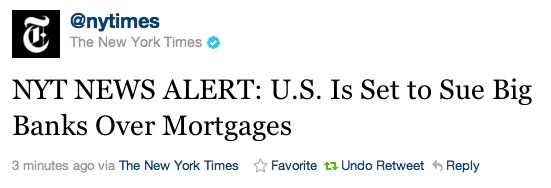
U.S. to sue banks over mortgages

U.S. to sue banks over mortgages: This oughta be fun. The list includes a over a dozen names, such as Bank of America, Goldman Sachs and JPMorgan Chase. “The suits will argue the banks, which assembled the mortgages and marketed them as securities to investors,” the article says, “failed to perform the due diligence required under securities law and missed evidence that borrowers’ incomes were inflated or falsified. When many borrowers were unable to pay their mortgages, the securities backed by the mortgages quickly lost value.”

Posted by ShortFormBlog • Permalink

Aug 18 2011W

Biz: Mortgage rates fall to their lowest level in 50 years

  • 4.15% the current rate for a 30-year fixed loan source
  • » To explain why this is important: Mortgage rates tend to go down when people aren't buying homes, as an incentive to get them to buy. When the economy was doing well back around 2000, this rate was around 8 percent. Now, the rate is so low that the last time it was this low, 30-year fixed loans weren't even widely available and the numbers were based on 20 or 25-year fixed loans. This particular statistic has been below 5 percent for the entire year, minus around two weeks.

Posted by Ernie Smith • Permalink

Feb 25 2011W

Biz: Bank Of America, Citigroup, Wells Fargo feel heat over mortgages

The current environment of heightened regulatory scrutiny has the potential to subject the corporation to inquiries or investigations that could significantly adversely affect its reputation.

A statement from Bank of America • Noting in a filing with the Securities and Exchange Commission that the company could be subject to huge penalties over their abusive mortgage practices. They're not alone; Wells Fargo and Citigroup ware in the same boat, and it's all thanks to the shady way that the trio dealt with their foreclosures. The reports from the companies suggest that all three will take a financial hit for said shadiness. Bank of America says that the state and federal inquiries “could result in material fines, penalties, equitable remedies (including requiring default servicing or other process changes), or other enforcement actions, and result in significant legal costs.” In other words, they're screwed for screwing over homeowners. Oops. source

Posted by Ernie Smith • Permalink