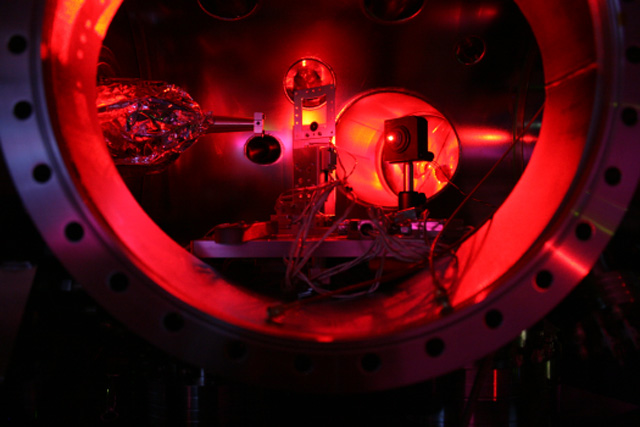
Hot dense matter, indeed: Scientists at the SLAC National Accelerator Laboratory have successfully super-heated a small piece of aluminum foil, as thin as spider silk, to a temperature of 3.6 million degrees Fahrenheit. They did this by hitting it with a rapidly pulsing, high-powered X-ray laser, which caused the foil to become what scientists refers to as "hot dense matter," commonly found only in places like the center of stars. This is the first time a sample has been able to be reproduced in a lab setting, and could lead to greater understanding of nuclear fusion, among other things — the 3.6 million degree matter was, in fact, hotter than the corona of our Sun. (Photo from University of Oxford/Sam Vinko)source
50trillionths of a second appeared to just "disappear" in a test source
» So, ever watch a TV show where the lead character breaks the fourth wall? Say, like "Malcolm in the Middle" or "Saved by the Bell"? They might even re-order things in time and space while talking to the audience. The other characters might be unaware of the gap in time created. Now imagine scientists doing that — with the help of lasers and special lenses called "time lenses." The process, called "temporal cloaking," is a bit more complex than that, and is a scientific novelty more than something the regular person can do something with at this point — but that doesn't make it any less awesome-sounding. Hop over to the full article for a deeper explanation.
 ShortFormBlog