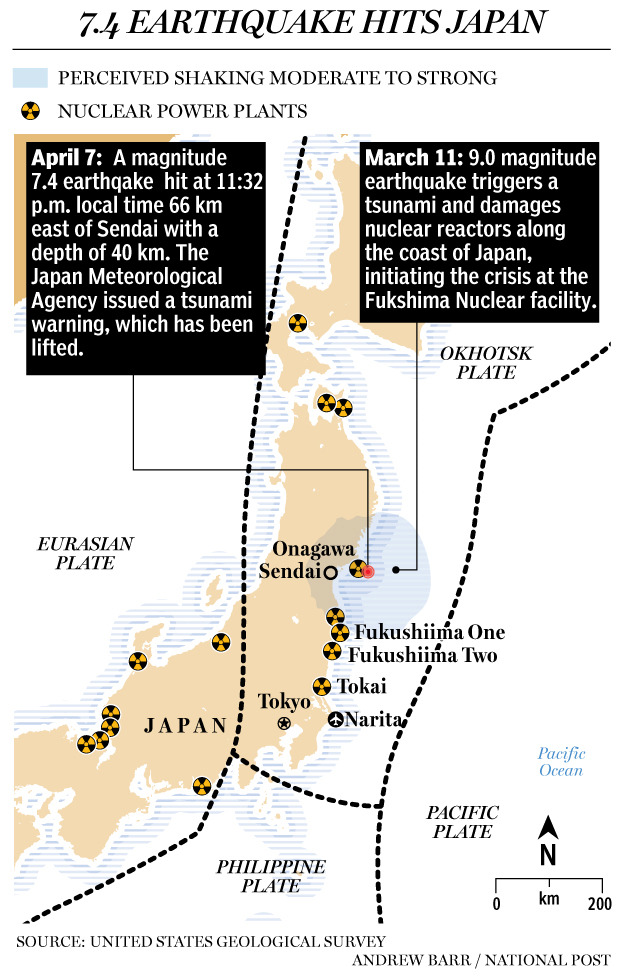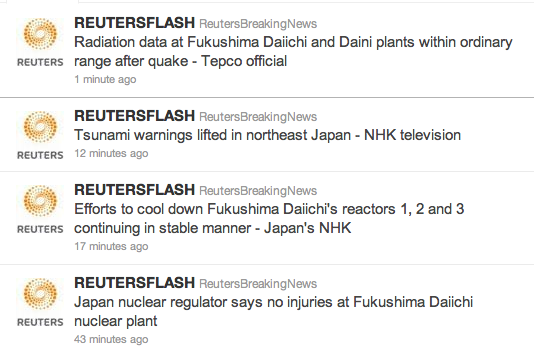
Yeah yeah, we know there’s a huge aftershock, but considering the messages here, “keep calm and carry on” seems like the mode of operation. That’s what the people of Japan are doing in trying to get this mess under control.
Tag: japan
232 posts
Tsunami warning lifted after 7.4 quake rattles Japan TOKYO — A strong earthquake of magnitude 7.4 shook the…
Tsunami warning lifted after 7.4 quake rattles Japan
TOKYO — A strong earthquake of magnitude 7.4 shook the northeast of Japan late on Thursday, and a tsunami warning was issued for the coast already devastated by last month’s massive quake and the tsunami that crippled a nuclear power plant.No damage from Thursday’s quake was detected at the plant and NHK said workers had been evacuated without reports of any injuries.
Japan is struggling to bring the Fukushima Daiichi plant under control after the March 11 quake and tsnumai, which killed, or left missing, about 28,000 people.
You guys work quick.
Posted by ShortFormBlog • Permalink
So, what happens to the people who died near Fukushima? Radiation makes that one complicated question.
Key quote: “They say the worst case is when you don’t have anything to bury or cremate, that’s why the surviving family members are desperate.“
Posted by ShortFormBlog • Permalink
U.S.: TEPCO: Fukushima's radioactive water no longer leaking into ocean
The leaks were slowed yesterday after we injected a mixture of liquid glass and a hardening agent and it has now stopped.
A TEPCO spokesman • Explaining that the radioactive seawater leaks from the Fukushima reactor apparently stopped. It just required some liquid glass, a hardening agent, and a little hope. Which is exactly what we needed that one time we stopped our server from melting down when Andrew Sullivan linked to us. source
Posted by Ernie Smith • Permalink
World: TEPCO begins draining radioactive water, tries to find major leak
- lesser evil TEPCO has begun releasing thousands of tons of radioactive water into the ocean, freeing up space to store the much more dangerously radioactive water they now have to contend with, a release of which would be much worse.
- square one Dye was used to determine the location of a leak of highly contaminated water, which TEPCO has fought for days. They didn't see it in the ocean outside, meaning the leak is not where they'd been trying to plug the past couple days. source
Posted by Chris Tognotti • Permalink
World: Unintended consequences, priorities complicate Japan crisis
- action Lacking the ability to pump water through the reactors at the Fukushima Daiichi plant as they usually would, workers were hosing in as much seawater as they could to try to cool the unstable fuel rods.
- outcome This consequently left the plant covered in contaminated salt water, and has made it extremely difficult for those in the plant to work near the reactors, thus impeding the crisis control effort. source
- »And don't forget about Japan's other problems: Prime Minister Naoto Kan was pretty unpopular prior to the earthquake and tsunami that decimated the country, and his abilities at crisis management haven't escaped public criticism. Reuters reports that many Japanese are unhappy with the Prime Minister's focus on the nuclear crisis, feeling that not enough attention is being paid to other pressing humanitarian tolls caused by the earthquake; the number of dead or missing currently sits at 28,000 people, though obviously that estimate is changing all the time. source
Posted by Chris Tognotti • Permalink
World: Japan's victims not seeing direct results from donations
- $1 billion the total donations for Japan's earthquake relief to the Red Cross
- none the amount of those donations that have gone directly to victims source
- » Yukiyo Edano says speed it up: Edano, the Japanese Chief Cabinet Secretary, explained that the standard procedure is for independent panels throughout the prefectures to decide how to handle the money; basically, distribution at the local level. This can slow the whole process when these communities are in such disarray, though, which is why Edano believes the central government should set up an independent committee. The Red Cross, it bears mentioning, has sent over 200 crisis relief teams into stricken areas. And it must be said in the strongest possible terms that we don't mean to discourage people who either have, or want to donate to Japan's relief efforts. Rather, we think it's worth understanding the functional realities that can hamstring those efforts. But the donations are nonetheless noble, vital, and necessary; none of this changes that.
Posted by Chris Tognotti • Permalink
World: Japan Prime Minister on Fukushima: We're not out of the woods yet
- Don't consider the situation at Fukushima settled just yet. That's the message that Japanese Prime Minister Naoto Kan, in his first statements on the matter in over a week, would like to make clear. "We are making efforts to prevent it from getting worse, but I feel we cannot become complacent," he said. "We must continue to be on our guard." Kan's comments come in the wake of high instability at some of the plants — yesterday, two workers got radiation burns on their feet while working on Fukushima's No. 3 unit, which is the most dangerous of the bunch due to its use of a mixture of uranium and plutonium. The situation led to fresh concerns about whether there might be a leak in that reactor. TEPCO officials are still looking for the cause of the high radiation levels. source
Posted by Ernie Smith • Permalink
U.S.: FDA's Fukushima food ban: Not really that big a deal
- scary The FDA just limited the import of food from the area of Japan near the Fukushima nuclear disaster, days after officials discovered radiation in some foods, including milk and spinach. A lot of people have been freaking out over this.
- not scary However, this almost assuredly isn't a big deal — only four percent of our imported foods come from Japan, and the ones we usually eat from the country are things like fish, which weren't significantly affected by Fukushima. source
Posted by Ernie Smith • Permalink
World: Scuba-capable Japanese man saves wife, mother
- problem Hideaki Akaiwa was at work when the dual threats of earthquake and tsunami rocked Japan. He went home to find his neighborhood was under ten feet of water, his wife and mother nowhere to be found.
- solution Akaiwa strapped on scuba gear and swam some 200 yards through debris (his estimate) to his house, where he found his wife. He found his mother that way, too, in the 2nd floor of another home. source
Posted by Chris Tognotti • Permalink