Read a little. Learn a lot. • Now Mullenweg-free! • Since 2009
☰

Tag: israel

231 posts

Mar 6 2012t

We all agree that the international community should demonstrate its commitment to a diplomatic solution by…

We all agree that the international community should demonstrate its commitment to a diplomatic solution by acknowledging Iran’s agreement to meet, by testing its desire to talk and by offering it the opportunity to respond to our legitimate concerns about its nuclear intentions.

— British Foreign Secretary William Hague • Discussing the decision that a group of six global powers agreed to resume talks with Iran over the country’s nuclear situation — a set of talks that had broken off about a year ago. The talks came as Israeli PM Benjamin Netanyahu, who sees Iran as his country’s most dangerous enemy, was in the U.S. to talk to Obama. Israel has seemingly been looking to possibly attack Iran’s nuclear facilities, but Obama has urged the country to continue to let diplomatic mechanisms to do the work. source ( source • source)
Posted by ShortFormBlog • Permalink

Mar 4 2012W

Politics: Obama speaks before skeptic AIPAC audience

Now is the time to heed that timeless advice from Teddy Roosevelt: speak softly, but carry a big stick.

President Barack Obama • Speaking before the American Israel Public Affairs Committee, the day before he is scheduled to meet with Israeli prime minister Benjamin Netanyahu. Although he was quick to condemn what he believed to be "too much loose talk of war", President Obama pleased many in attendance when he confirmed he would not support "containment" of a nuclear-armed Iran. When asked about the possibility of military intervention, the President replied, "I will not hesitate to use force when it is necessary to defend the United States and its interests." source

Posted by Scott Craft • Permalink

Feb 29 2012W

World: Israeli officials urge U.S. to impose "suffocating" sanctions on Iran

Suffocating sanctions could lead to a grave economic situation in Iran and to a shortage of food. This would force the regime to consider whether the nuclear adventure is worthwhile, while the Persian people have nothing to eat and may rise up as was the case in Syria, Tunisia and other Arab states.

An unnamed Israeli official • Calling for the U.S. to cripple Iran's economy with harder sanctions, to cause food shortages for the Iranian public as a means to gain diplomatic leverage. The impetus of this thinking came earlier today, when North Korea agreed to halt production of new nuclear weapons in exchange for food aid. While respecting the existential concern Iran's nuclear prospects pose for Israel, the fact that the U.S. would itself impose a food shortage (unlike North Korea, where state mismanagement and famine were to blame) seems like it would aim the Iranian public's outrage outward, not inward. The Arab spring had much do with economics, Tunisia's high unemployment, for example, but a foreign state inducing hunger and starvation, and hoping people will therefore turn against their own government? That seems highly unlikely, as well as morally dubious. source

Posted by Chris Tognotti • Permalink

Feb 28 2012t

Israeli officials said that if they eventually decide a strike is necessary, they would keep the Americans in…

Israeli officials said that if they eventually decide a strike is necessary, they would keep the Americans in the dark to decrease the likelihood that the U.S. would be held responsible for failing to stop Israel’s potential attack. The U.S. has been working with the Israelis for months to persuade them that an attack would be only a temporary setback to Iran’s nuclear program.

— An AP article suggesting that Israel will keep the U.S. out of the loop if it tries attacking Iran. Well, until now, that is. Good work uncovering this one, Associated Press. Now they just lost deniability. (via @BreakingNews)

Posted by ShortFormBlog • Permalink

Feb 16 2012t

This issue was about individuals and the targets were specific. This was something personal.

This issue was about individuals and the targets were specific. This was something personal.

— Thailand’s national police chief, Gen. Prewpan Dhamapong • Discussing recent attacks committed by Iranians in his country. Here’s the big reveal: They now “know for certain that (the target) was Israeli diplomats.” This bolsters Israel’s evidence that a series of diplomatic attacks earlier this weekmight’ve been tied to Iran.

Posted by ShortFormBlog • Permalink

Feb 14 2012W

World: Was Tuesday's Bangkok explosion tied to Iran, too? Israel says yes.

  • monday Israel blames the bombings of their embassy vehicles, in both India (successful) and Georgia (foiled), on Iran. Despite this, Iran denied responsibility for the attacks.
  • tuesday In Bangkok, an Iranian man carrying grenades managed to blow his own legs off and wound four others. Israel also blamed this attack on Iran. source

Posted by Ernie Smith • Permalink

Feb 13 2012t

It wouldn’t be the first time

inothernews:

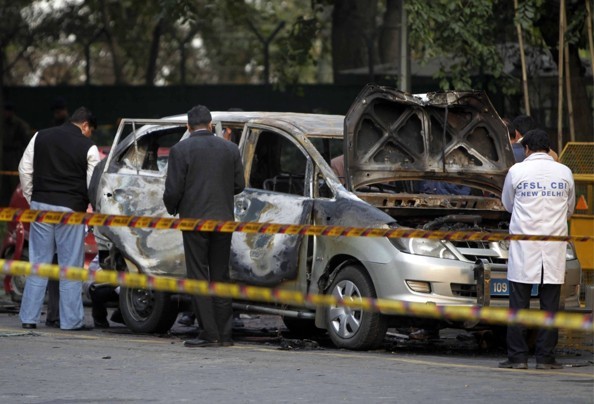
Indian security and forensic officials examine a car belonging to the Israel Embassy after an explosion tore through it in New Delhi on Monday. The driver and a diplomat’s wife were injured, according to Indian officials. A second bomb was defused outside the Israeli Embassy in Tsiblisi, Georgia; prime minister Benjamin Netanyahu blamed the apparently coordinated incidents on Iran. (Photo: Mustafa Quarishi / AP via the Washington Post)

It wouldn’t be the first time an embassy attack was pinned on Iran, whether or not it was actually the case.

Posted by ShortFormBlog • Permalink

Jan 11 2012W

World: Hillary Clinton denies U.S. involvement in Iran nuclear scientist's bombing death

I want to categorically deny any United States involvement in any kind of act of violence inside Iran. We believe there has to be an understanding between Iran, its neighbors and the international community that finds a way forward for it to end its provocative behavior, end its search for nuclear weapons and rejoin the international community and be a productive member of it.

Secretary of State Hillary Rodham Clinton • Defending the U.S. from allegations that they were behind a bombing that led to the death of an Iranian nuclear scientist. Despite this claim, the Iranian government pointed its finger at Israel and the U.S., saying they placed a magnetic bomb on Mostafa Ahmadi Roshan's vehicle. Israeli Prime Minister Benjamin Netanyahu, meanwhile, declined making a statement on the bombing; many diplomats and analysts in Washington feel that Israel may be behind the series of covert killings of prominent Iranian nuclear scientists over the past two years. No matter whether the U.S. is involved, the attacks are nonetheless ratcheting up tensions between Iran and the West at a tough time for said tension. source

Posted by Ernie Smith • Permalink

Jan 11 2012W

World: More on the killing of Iranian nuclear scientist Mostafa Ahmadi Roshan

  • How it happened: Mostafa Roshan was being taken to work when two people on a motorcycle attached a magnetic bomb to the side of his car, which then exploded. Roshan was killed in the blast, and his driver suffered fatal wounds. Roshan, the deputy director of commerce for the Natanz uranium enrichment facility, was likely targeted for his prominent role in the facility, which is at the center of a major controversy over what the U.S. sees as a push by Iran to create nuclear weapons. Roshan, in his role, would likely have been in charge of procuring materials to build nuclear fuel. The U.S. has denied any role in his death. source

Posted by Chris Tognotti • Permalink

Dec 16 2011t

Let’s hope that

nationalpost:

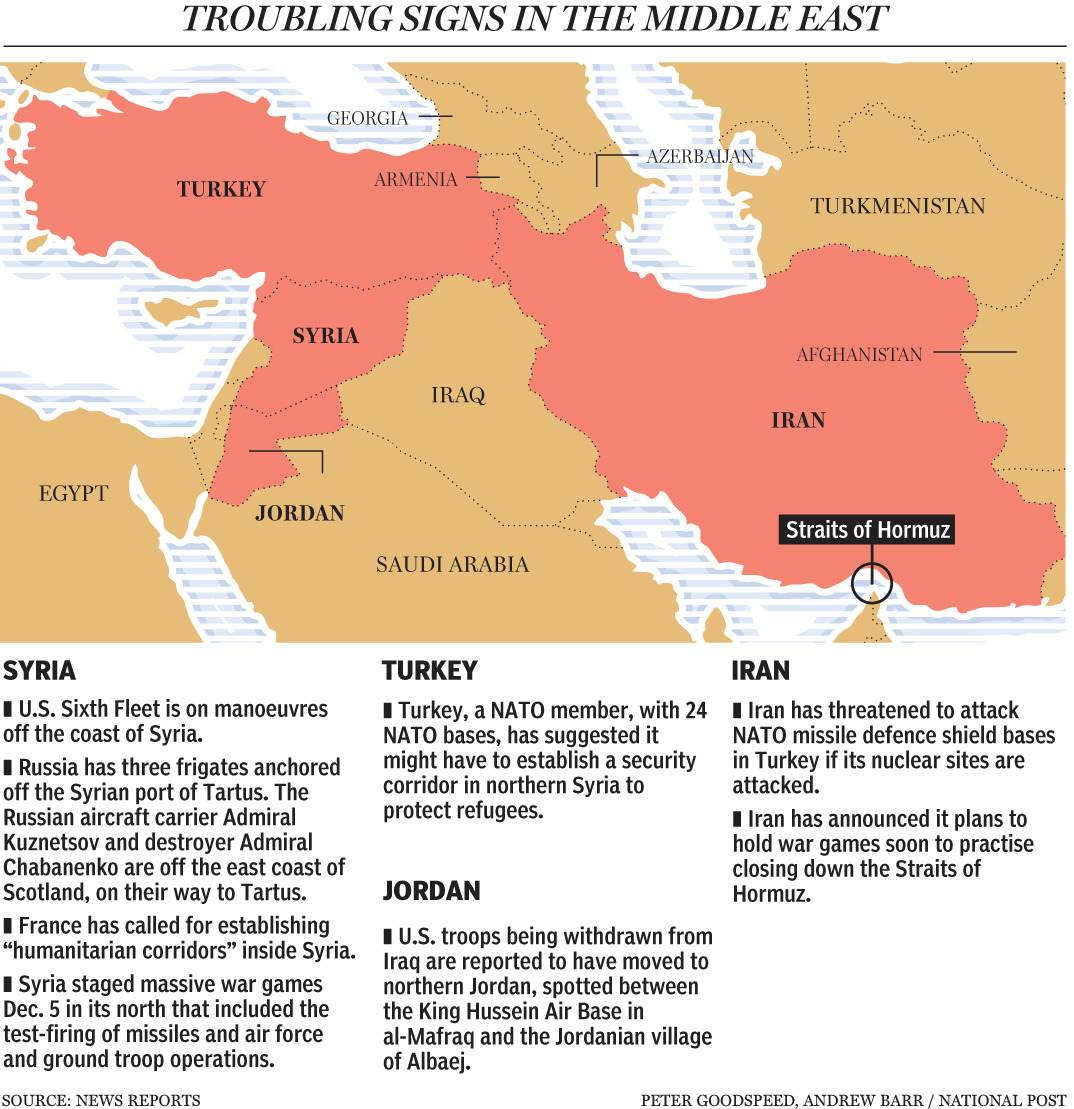
Middle East on the brink of war: analysis
As Syrian dictator Bashar al-Assad clings to power with the quiet backing of regional powers Iran and Russia, the Middle East may be sliding slowly into war.

Squeezed between the rebellions of a bloody Arab Spring and growing fears of a possible military response to Iran’s growing nuclear threat, the region is becoming increasingly unstable.

“I would be very surprised if it turned into a Russian-American war, but this could be a Mid-East war: Hezbollah, Hamas, Iran, Syria, Israel all having at each other,” said Jack Granatstein, military historian and senior research fellow at the Canadian Defence and Foreign Affairs Institute.

Let’s hope that the region doesn’t get any more volatile than it already is. Do you think this analysis is spot-on?

Posted by ShortFormBlog • Permalink