Read a little. Learn a lot. • Now Mullenweg-free! • Since 2009
☰

Tag: internships

13 posts

Oct232013t

Condé Nast Discontinuing Internship Program

Condé Nast has decided to discontinue its internship program starting in 2014, WWD has learned. The end of the program comes after the publisher was sued this summer by two former interns who claimed they were paid below the minimum wage during internships at W and The New Yorker.

Condé is just one of several media companies facing similar litigation from summer interns. In February 2012, a former intern at Hearst’s Harper’s Bazaar sued, claiming the magazine violated minimum wage and overtime laws. A judge threw out the case, but the intern appealed and the suit remains unresolved. In another case that was settled in June, two interns who worked for Fox Searchlight successfully sued the studio for similar reasons.

For a bit more context on the situation, we suggest referring back to Ernie’s post on the Black Swan unpaid intern case, which is still winding its way through the court system as we speak.
Posted by Scott Craft • Permalink

Aug302013t

Wanted: Unpaid interns to work for free in the Senate. Oh yeah, it's in DC, which isn't cheap

  • 35 the number of Senate offices that pay their interns for the work they do, which they can do based on federal law. That said, if you’re looking to get a couple of bucks out of the gig, you better hope you’re working for a Republican—despite being the majority party, just 11 Democratic senators pay for your right to work for them—and 80 percent of Senate Democrats are asking for volunteers.

Posted by Ernie Smith • Permalink

Jun172013t

Why it's better to be a paid intern than an unpaid intern

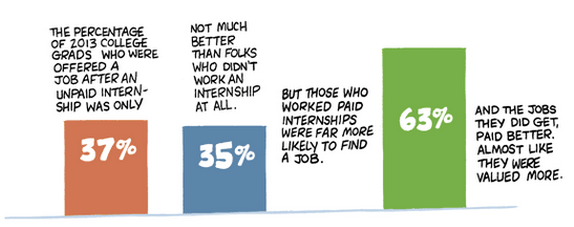
  • 63% the percentage of paid internships that led to job offers for 2013 graduates, according to a study by the National Association of Colleges and Employers (NACE). To compare, just 37 percent of unpaid internships led to full-time jobs. And those who received paid internships got paid more at their real jobs, too. “In each survey, paid interns exceeded their peers in job offers and starting salaries,” NACE’s executive director, Marilyn Mackes, said.

Posted by Ernie Smith • Permalink

Jun142013t

What you should know about the Black Swan unpaid intern case

What you should know about the Black Swan unpaid intern case

The ballerinas weren’t the only tortured souls on the set of Black Swan. Some of the unpaid interns on the set found themselves doing the kind of menial labor (i.e. grabbing coffee) that they didn’t go to school for. And on Wednesday, a court agreed, ruling that 1) the interns should have been paid for their time and 2) opened up the company behind the film, Fox Entertainment Group, up for a class-action lawsuit. “Judge [William H.] Pauley’s ruling might still symbolize the tipping point in the battle over unpaid internships. Unless a higher court steps in, some judges might choose to follow his lead in the future,” The Atlantic’sJordan Weissmann writes, noting that the case could scare some companies off from using unpaid interns for liability reasons. (Side note: We’ve been following the unpaid internship issue lately, and I wrote a Medium post about the topic you should read.)

(thanks Sara Schwartz)

Posted by Ernie Smith • Permalink

Jun122013t

My foot in the door: Fortunately, it was paid.

I won’t sugar-coat it. That my foot crossed the threshold into the crease of the door is pretty amazing, and I’m still, nine years later, sort of amazed it happened.

Following up on the ProPublica Kickstarter regarding unpaid internships I pointed out last night, I wrote a post on Medium about how a paid job post-graduation was a major lifeline career-wise—and if that job was an unpaid internship instead, how it might not have actually happened. — Ernie @ SFB

Posted by Ernie Smith • Permalink

Jun112013t

A Crowdfunded Investigation of Internships

amzam:

futurejournalismproject:

A Crowdfunded Investigation of Internships

ProPublica:

Late last month, ProPublica launched a Kickstarter to cover the costs of hiring an intern to help with our internships investigation. Our intern will create a microsite on the intern economy, traveling around the country to collect interns’ stories that will supplement and enhance our more traditional watchdog reports. But to do this, we need to raise $22,000 by June 27.

Our editor-in-chief Steve Engelberg sat down with ProPublica’s community editor Blair Hickman and news application fellow Jeremy Merrill to talk about our unique approach to investigating the intern economy.

“Beyond the Kickstarter, from a reporting perspective and project perspective, what’s particularly noteworthy about this is we’re starting with community and we are starting with data and news applications,” said Hickman about the project. “We’ve said from the get-go, we are investigating internships and we’re doing this in a very open way — which is a little bit different than our normal investigations. And because of that, we’ve gotten a ton of tips flooding in and we’re starting to do news reports off of that. But it’s starting with the crowd.”

FJP: This will be fantastic. Here’s a link to the Kickstarter, and here’s a podcast about the project. Reminds us of Ross Perlin’s Intern Nation, which is a fairly interesting read.

Thank you for Tumbling!!

You want to solve the intern problem? Consider donating to this pretty darn awesome idea for an investigation.

Posted by Ernie Smith • Permalink

May312013t

Important comment above.

journosofcolor:

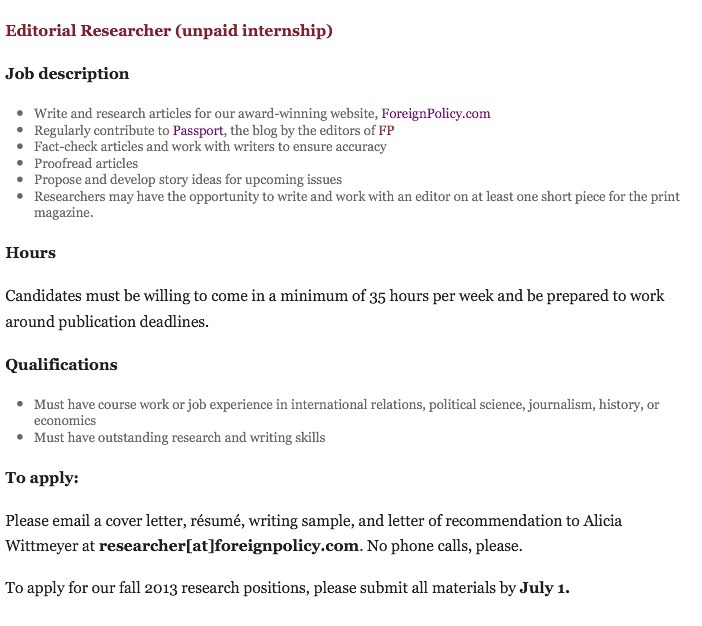
A job posting at the prestigious foreign policy magazine for an editorial assistants job.

They want you to write, pitch, fact-check and research, five days a week, for at least 35 hours a week. A full-time job, in other words.

How much are they willing to pay? Nothing at all. They want your labor, for free. And what do they offer in return? Experience. That’s it.

If you’re wondering why it’s hard to find people from low-income backgrounds in elite journalism—which, disproportionately, means people of color—look no further than this. The only people who can afford to work full-time for free come from wealth, and generally, if you’re wealthy in America, you’re white.

It’s a barrier to entry that keeps the field closed to everyone but our affluent, (almost certainly) Ivy-educated elites. That’s a problem.

Important comment above. (Also relevant.)

Posted by Ernie Smith • Permalink

Feb202013t

How lower-income Americans are shut out of journalism — MSNBC

journalofajournalist:

According to MSNBC’s Ned Resnikoff, systematic usage of paid internships disproportionately shuts out working-class and lower-middle-class writers from journalism careers. Do you agree?

This is a definite issue for young journalists — though not across the board. Many newspapers, for example, offer paid internships, and when I started in the industry, I was lucky enough to get a temporary job that was paid. (Magazines, traditionally, are less likely to offer paid internships.) So I definitely feel for journalists struggling to make a career out of this. Good on The Ed Show for raising the issue, though the next question is, what are NBC’s own practices on the matter? — Ernie @ SFB

Posted by Ernie Smith • Permalink