EDIT: According to the article, they’re working on getting an accurate reading again. They just know it’s not 1,000 millisieverts per hour, or 10 million times its normal level. Once we hear what it is, we’ll post.
Tag: Fukushima
115 posts
World: Japan update: Lots of people trying to get Fukushima under control
- 700+ engineers are battling the Fukushima crisis source
- » Progress, but no end in sight: Chief Cabinet Secretary Yukio Edano had these vaguely calming words about the incident: "We are preventing the situation from worsening — we've restored power and pumped in fresh water — and making basic steps toward improvement," he said, "but there is still no room for complacency." There are good and bad parts about the overall situation right now — while aftershocks are starting to tail off, radiation levels in seawater miles away are very high, but are said to be of little threat to those eating seafood from the ocean. Still, though …
Posted by Ernie Smith • Permalink
World: Japan Prime Minister on Fukushima: We're not out of the woods yet
- Don't consider the situation at Fukushima settled just yet. That's the message that Japanese Prime Minister Naoto Kan, in his first statements on the matter in over a week, would like to make clear. "We are making efforts to prevent it from getting worse, but I feel we cannot become complacent," he said. "We must continue to be on our guard." Kan's comments come in the wake of high instability at some of the plants — yesterday, two workers got radiation burns on their feet while working on Fukushima's No. 3 unit, which is the most dangerous of the bunch due to its use of a mixture of uranium and plutonium. The situation led to fresh concerns about whether there might be a leak in that reactor. TEPCO officials are still looking for the cause of the high radiation levels. source
Posted by Ernie Smith • Permalink
World: Experts: Fukushima nuclear situation getting under control
The reactors are more stable as time progresses. By now, the decay heat is greatly reduced and it becomes easier to supply sufficient water for cooling. As far as we know, the containments are holding and the radiation levels have dropped.
UC Berkley nuclear expert Peter Hosemann • Suggesting that Fukushima is quickly becoming less of an issue, and more under control. He does warn, however, that radiation may still get into the environment: "We might see some more release of radioactive material, mostly due to the water going through the systems." Overall, though, this is promising in terms of getting things handled. source
Posted by Ernie Smith • Permalink
According to VOA,
Embedded media from serve.a-widget.com is no longer available.
Ex-Rad: The U.S. government’s new anti-radiation drug?
According to VOA, the U.S. government (along with a drug firm named Onconova) is currently working on an anti-radiation drug called Ex-Rad. “Ex-Rad is a drug which is effective in saving a cell damaged by radiation,“ says Onconova CEO Ramesh Kumar, "and we have found that it can be given in advance of exposure to radiation up to a day ahead or it can be given up to a day after the exposure to radiation.” If this is true, it’s worth keeping an eye on. source
Posted by ShortFormBlog • Permalink
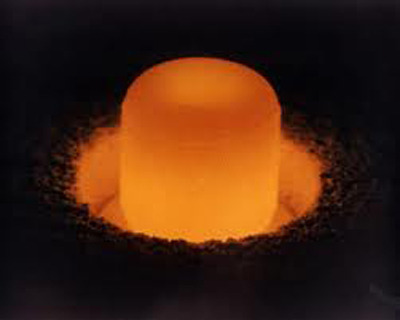
Japan Nuclear Crisis: What About The Plutonium MOX?
The media tells us that things are looking much better now in regard to the Japan nuclear crisis and we should all relax about the damaged nuclear reactors in Fukushima.
Yet, there is something bothering us in London which makes it difficult for us to relax completely…
If the smoke billowing from the Fukushima reactor 3, amongst other reactors, does indeed contain plutonium, then this nuclear crisis has exposed Japan and the world to a much more extreme danger than the one originally envisaged. If so, we all ought to know about it. There should be some more specific investigations in regard to the contents.
Plutonium is one of the most lethal known health hazards.
See also 3/17: “Plutonium is the heaviest primordial element”
Proliferation and safety problems of MOX use
Mixed Oxide (MOX) Fuel | image source
This article, written by a risk assessment group, is purely speculative (and a couple days old), but The Guardian has been concerned about this too: “The condition of the No 3 unit is of particular concern as it contains plutonium-uranium mixed oxide fuel and would release highly toxic plutonium in the event of a meltdown.” Worth noting, but take with a grain of salt.
Posted by ShortFormBlog • Permalink
U.S.: FDA's Fukushima food ban: Not really that big a deal
- scary The FDA just limited the import of food from the area of Japan near the Fukushima nuclear disaster, days after officials discovered radiation in some foods, including milk and spinach. A lot of people have been freaking out over this.
- not scary However, this almost assuredly isn't a big deal — only four percent of our imported foods come from Japan, and the ones we usually eat from the country are things like fish, which weren't significantly affected by Fukushima. source
Posted by Ernie Smith • Permalink
World: Power lines connected at Fukushima Daiichi, not turned on yet
- Power lines up in all six Fukushima Daiichi reactors: Which is great sounding news, but they're not out of the woods yet. There are a number of implications to this, mainly that cooling systems can be turned back on, thus pumping water back into the reactors and preventing a meltdown of the fuel rods. However, the power hasn't yet been switched on, as engineers fear that the pumps, damaged as they are, could cause an explosion if activated abruptly. That aside, this news is a credit to the bravery of the workers who stayed at the plant. We hope the government gives them truly first-class care once this is over, it's the only moral thing to do. source
Posted by Chris Tognotti • Permalink
World: China, South Korea strictly checking Japanese food
- China and South Korea wary of radiation in food: Some countries (and even individual restaurants) that import food from Japan are concerned about the possibility of radiation contamination. The Japanese government has assured their citizenry that the radiation levels detected in milk, spinach, and some water is not enough to do rapid or lasting damage, though they've imposed a freeze on food from that region. China and South Korea want to look into the matter themselves, though, absent the responsibility of keeping the Japanese citizenry from being stricken with panic, which their government obviously has. That seems reasonable enough. source
Posted by Chris Tognotti • Permalink
Politics: Max Headroom: Glenn Beck, Lawrence O'Donnell ignore Japan for pettiness
- Meanwhile, while Glenn Beck and Lawrence O'Donnell are arguing/agreeing about whether or not the Japan nuclear crisis is going to end the world (it's not), thousands have been killed, thousands more are currently without a roof over their head, and millions more could face electricity issues for months after the Japan quake seriously damaged the power grid. Good to see they're keeping things in perspective by arguing over who's right. source
Posted by Ernie Smith • Permalink
