Read a little. Learn a lot. • Now Mullenweg-free! • Since 2009
☰

Tag: diplomacy

101 posts

Feb 12 2011t

The Only Plfrmat: More on Israel in the wake of Egypt

shortformblog:

Really good comment

There’s a lot that theonlyplfrmat has going on with this post, but the key point that he’s drilling at is that Israel is playing a long-term ballgame, and Mubarak’s leadership, and the stability it encouraged, was a key part of said ballgame. (There’s an element of Obama playing both sides by encouraging the army to take over, but we’re going to see where that situation goes before passing judgment.) There are a lot of emotions at play with Egypt’s situation, but Israel doesn’t benefit from seeing any sort of change in leadership. There’s too much risk that it could go the wrong way and lead to the kind of tensions that saddled the nation for decades after its birth.

Again, all of this is fair, But the excitement that comes with young democracies needs to be emphasized. Where Egypt goes next, there are no clear signs. But the key thing is that a firm democracy will likely be put in, and, even if the military and folks like Omar Suleiman influence the overall direction, the opposition will likely have some role in shaping it. This shape is what Israel is afraid of. If it goes too far in the wrong direction, it could greatly hurt them. Or it may not. It’s an unknown entity.

The point I’d like to add to all of this is that this shouldn’t entirely be about what Israel gets. The main goal should be to benefit the entire region. Maybe it’s naive, but Israel has the kind of stable, secular democracy that the Egyptians and the Tunisians are attempting to work towards. Granted, Israel hasn’t exactly had the easiest of times in the region, but the more stable secular democracies, the better, right? In the long run, that’s how Israel gets lasting stability in the region – more radical, non-secular voices lose influence over the government and the democratic process. There are probably more guys like Wael Ghonim out there than hardcore Islamists.

Larry Derfner of the Jerusalem Post makes a pretty good point that hues most closely to my feeling on the matter, overall: “It’s fear that’s dictating the Israeli reaction. But there’s such a thing as too much fear. I think most people who know about Egypt, who are looking at Egypt and trying to be level-headed about it, are saying that Muslim Brotherhood is probably not going to take over Egypt, and that the movement in Egypt is dominated by democrats.”

Derfner says it’s about Egypt playing ball with the West, no matter what happens. And that’s the thing. The Brotherhood only cautiously supported the movement after it gained momentum, and they were the first to side with Suleiman an any sort of drawn-out transition movement (the one that was eventually pushed aside). It’s too early to tell what’s going to happen, but Israel’s fears may not even be warranted.

Whatever happens in the long-term, it’s best to keep a watchful eye and an open mind, in my opinion. Which is what I guess I’m suggesting Israel should be doing.

Thanks for the thoughtful response. Hopefully this one is nearly as thoughtful.
Posted by ShortFormBlog • Permalink

Feb 10 2011W

World: Mubarak's speech: Why the United States needs to look inward

  • "I can not and will not accept to be dictated orders from outside, no matter what the source is." What makes a leader, in the face of international, media and local scrutiny, choose not to listen to repeated calls to resign? Who essentially shames his allies? A man whose statements are so transparent that not even his own people believe them? And why is it that the world allowed him to gain so much authority that he can't easily be toppled from his position? There are a lot of questions tonight, and we've been parsing through them all afternoon. The fact that Mubarak was effectively supported by the United States makes the question marks much more pointed. As Americans, we need to learn how to encourage democracy at all costs, and focus less on what we gain – leverage in Israel, influence in a region, whatever. We can't support another military state created by the United States. It's ended in tears multiple times, and every time, Americans lose out monetarily, civilians lose their rights, and our world becomes a little more unstable. No more. This has to stop. source

Posted by Ernie Smith • Permalink

Feb 1 2011t

On Egyptian copycats and United States diplomatic interests

abbylovesfilm asks: Who do you think will be the next country in the region to follow in Tunisia and Egypt’s footsteps?

050458 asks: What are the implications of Mubarek stepping down on US-Egypt ties? After all, he was one of those dirty little dictators the US propped up

  • » We say: For the first question, we think that the next countries which could face this sort of trouble are numerous. Our best prediction would be that protests would continue to heat up in Jordan or Yemen. Or they could start flaring up in Libya, Egypt’s neighbor to the west, which has a pretty controversial leader of its own in Muammar al-Gaddafi. As for the second – it honestly depends on who gets in power. If it’s one of Mubarek’s lackeys, or someone tied to the military, the odds favor a relationship that’s still fairly stable (if unfavorable for the people of Egypt). But if someone less appreciative of the Israeli state goes in, it could be really bad – for the U.S. For Egyptians, that may be a better option. All this stuff, though, is really too early to predict.

Posted by ShortFormBlog • Permalink

Jan 29 2011W

World: Two presidencies, two tactics: How Obama, Bush handled Egypt

  • 2005 In the wake of protester arrests, and emphasizing free elections, Condoleeza Rice angered Egyptian leaders with this statement: “For 60 years, my country, the United States, pursued stability at the expense of democracy in this region here in the Middle East, and we achieved neither."
  • 2009 Obama made his own speech in Cairo, emphasizing "the ability to speak your mind and have a say in how you are governed" and "confidence in the rule of law and the equal administration of justice" while noting “there is no straight line to realize that promise.” Mubarak’s folks were thrilled. source
  • » Ultimately, though: While these American statements resonated with the leadership, they didn't really resonate with the people of the country, who are working from their own muse. And based on the current deck of cards, the U.S. may have trouble holding any influence at all due to their history with Egypt: “It’s not clear to me that the protesters will take seriously expressions of solidarity from a country that’s been backing autocratic regimes,” said the International Crisis Group's Robert Malley, who suggests that American leaders will back themselves into a corner if they say anything, whether supportive of Mubarak or the protesters.

Posted by Ernie Smith • Permalink

Jan 28 2011W

Politics: The Guardian: Assessing the diplomatic damage in Egypt

The revolution threatens not only Hosni Mubarak's regime but the strategy the US and Britain have constructed in the Middle East. The hesitancy with which President Mubarak reacted last night was matched only by the perceptible shift in the emphasis of the statements by the U.S. secretary of state, Hillary Clinton.

An editorial by The Guardian regarding Egypt • In an editorial about Egypt which we thinks relates well to a question we just answered on Tumblr not that long ago. The Guardian makes their point pretty well, we'd say: "Faced with the conflicting needs to keep an Arab partner of Israel afloat and to respond to demands for democratic reform, the U.S. would choose the first every time." The Guardian makes three points: First, a regime change would possibly damage long-term diplomatic goals; second, if Mubarak has any chance of leaving office peacefully, he's going to have to free Mohamed ElBaradei and other prisoners, and open up the Interwebs; and finally, this juggernaut may be too difficult to stop at this point. source

Posted by Ernie Smith • Permalink

Jan 10 2011t

More on Iran's myriad airplane maintenance problems

seaofgreen:

shortformblog:

sadafie says: So sad. Not sure I appreciate shortformblog’s take though. Plane crashes are an unfortunate reality and happen all around the world. When they do happen, more often than not, they’re related to mechanical malfunctions. That doesn’t mean that a country cares less about it’s people. Just sayin’… I’d be interested in the full story. » We say: They are, yes, and I don’t mean to downplay the awfulness of this situation. I was just noting that Iran specifically has a reputation for poor care for/lack of refurbishment of their air fleet, leading to a higher likelihood of crashes. From the article: “The country’s civil and military fleet is made up of ancient aircraft in very poor condition because of their age and lack of maintenance. In Iran’s worst air accident, a plane carrying members of the elite Revolutionary Guards crashed in February 2003, killing 302 people on board.” The article lists three other major air incidents since the 2003 crash. It’s not so much suggesting that Iran doesn’t care about their citizens, but questioning their priorities as a country. By alienating the West in part because of the nuclear program, they’ve allowed their air fleet to become dilapidated, leading to these insane crashes. (This 2003-era BBC article offers further context on the planes being used and why they’re so hard to maintain.) Engine problems are common, but they’re even more common when you’re using Soviet-era planes and don’t have access to the parts to fix them.

You have some facts rights, but you’ve missed the core problem: It’s the American sanctions which have kept Iran’s fleet of aircrafts in such poor condition. This has been reported on for decades. Reza Nakhjavani, the head of Iran’s Civil Aviation Organization, has gone so far as to say that the U.S. sanctions against Iran’s aviation industry is “inhumane,” and that the blockade of spare Boeing parts is similar to “denial of needed medical supplies.”

Wired: Sanctions Keep Vintage Aircraft Flying in Iran

HuffPo: Experts say. U.S. sanctions prevent Iran from updating its 30-year-old American aircraft and make it difficult to get European spare parts or planes.

Wikipedia: Due to U.S. sanctions, Iran is unable to buy new Western aircraft (whether commercial or military), nor spare parts for existing aircraft from U.S. manufacturers. American-built military planes now operating in Iran were purchased under the old regime during the 1970s. Iranian officials blame the country’s poor aviation record on the sanctions.

This issue has nothing to do with Iran having misplaced priorities and everything to do with outdated, inhumane sanctions which the international community should demand to have removed immediately.

I believe I was talking around the very issue, but coming at it with the opposite result. Yeah, the U.S. is indirectly enforcing a fairly draconian standard for Iran’s air fleet (for diplomatic reasons), but if Iran were more willing to diplomatically give on their end, they could help solve their own problem. My ultimate feeling is that the answer lies somewhere in the middle.

The West has a very strange relationship with Iran. It’s to the point where Iran’s leadership can pretend to sort of think about doing something that the West wants them to do, ratchet up anticipation, and then pull out a stunner in the fourth quarter. I don’t necessarily think that we should be handing them what will obviously be perceived as a victory, but you may be right that the human rights issues with this are starting to become a little too troublesome to ignore.

Good counterpoints.

Posted by ShortFormBlog • Permalink

Jan 9 2011W

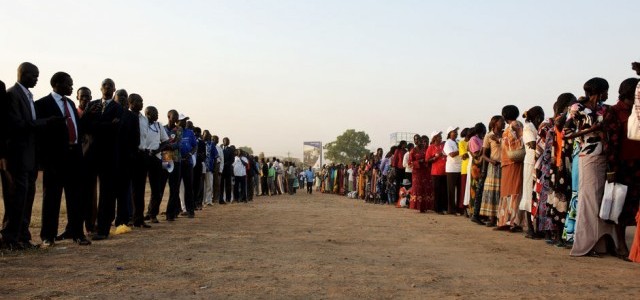
World: Hey everybody! Think good thoughts for Sudan today

  • Today, southern Sudan votes for independence: In potentially heartwarming news, Southern Sudan could be placed in charge of its own destiny if the vote in the country favors an independent state. As we noted last night, Obama has been pushing for this. Considering the recent electoral strife in the African continent (looking at you, Ivory Coast), it would be great news if this particular election went well. source

Posted by Ernie Smith • Permalink

Jan 8 2011W

World: Obama to Sudan: Please keep voting process peaceful. Please?

As the referendum proceeds, voters must be allowed access to polling stations; they must be able to cast their ballots free from intimidation and coercion. All sides should refrain from inflammatory rhetoric or provocative actions that could raise tensions or prevent voters from expressing their will.

President Barack Obama • In an editorial, published in the New York Times, emphasizing the need for an honest vote in Sudan tomorrow, where they'll be deciding whether to split the southern part of the country from the main country – a vote that Obama has long pushed for diplomatically. Obama suggests that if Sudan follows through with the vote without incident, the Khartoum region's government could be taken off a list of state sponsors of terrorism. He also emphasizes that Darfur is also important to this peace process: "There can be no lasting peace in Sudan without lasting peace in the western Sudan region of Darfur." We're totally with him on this. source

Posted by Ernie Smith • Permalink

Dec 29 2010t

On South Korean unification efforts and why now is a bad time

cokeverbsipads said: Actually GOOD idea. Korean reunification is an essential part of the culture on BOTH sides of the border.

  • » We say: While not meaning to disrespect anyone’s culture here, there’s a fundamental problem here, which is that forcing such an issue in a time of volatility just makes things worse. That’s why Israel and Palestine don’t go back to the negotiation tables until the U.S. has broken the ice between the two nations. The problem here is diplomatic. South Korea risks angering at least two of its neighbors by going down this path. Ease the relationship first and break the ice, then go back to the table. The concept is good. The timing is bad.

Posted by ShortFormBlog • Permalink