Read a little. Learn a lot. • Now Mullenweg-free! • Since 2009
☰

Tag: arab spring

50 posts

Dec 28 2011t

The "virginity tests" carried out by Egypt's military are now banned, thanks to a court ruling.

The Daily Beast:

A court in Egypt has forbidden the Army from carrying out so-called virginity tests on female detainees. The verdict was delivered in the case of Samira Ibrahim, a 25-year-old marketing manager and activist brave enough to defy the country’s Army.

In March of this year, military forces violently broke up a sit-in of protesters who had continued to camp out in Tahrir Square after Mubarak’s ouster. Women as well as men were arrested. According to testimony they gave to international human-rights groups, the women were insulted, accused of prostitution, beaten, and tortured. At a military camp to which they were transported, seven of the women—those who were unmarried—were subjected to “virginity tests,” stripped and inspected by a male military doctor while soldiers and officers looked on.

One person makes a difference: There were numerous reports of said “tests” being carried out by the Egyptian army, but Samira Ibrahim was the only woman to come forward publicly and file a lawsuit. “On that day, I truly wished for death,” she said in a video testimony. “I kept telling myself, people get heart attacks and die, why don’t I get one?” Problem is, Egyptian courts don’t have jurisdiction over military personnel, so while policy will change to reflect the ruling, it’ll be up to the military itself to press charges against any of its officers. So far, it has announced that it will charge one army doctor with “public indecency and violation of orders.”
Posted by ShortFormBlog • Permalink

Dec 27 2011t

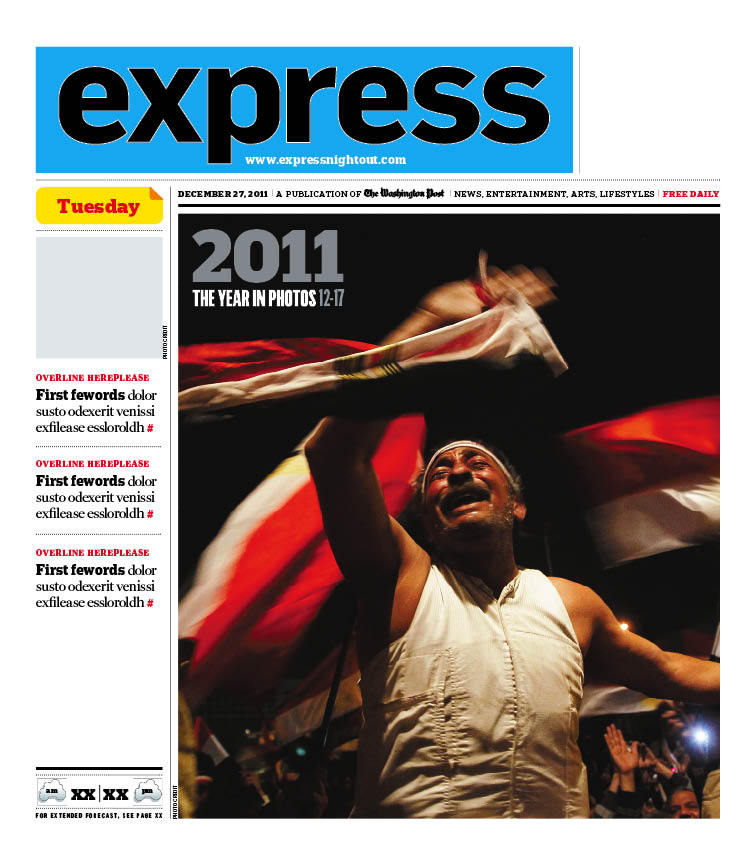
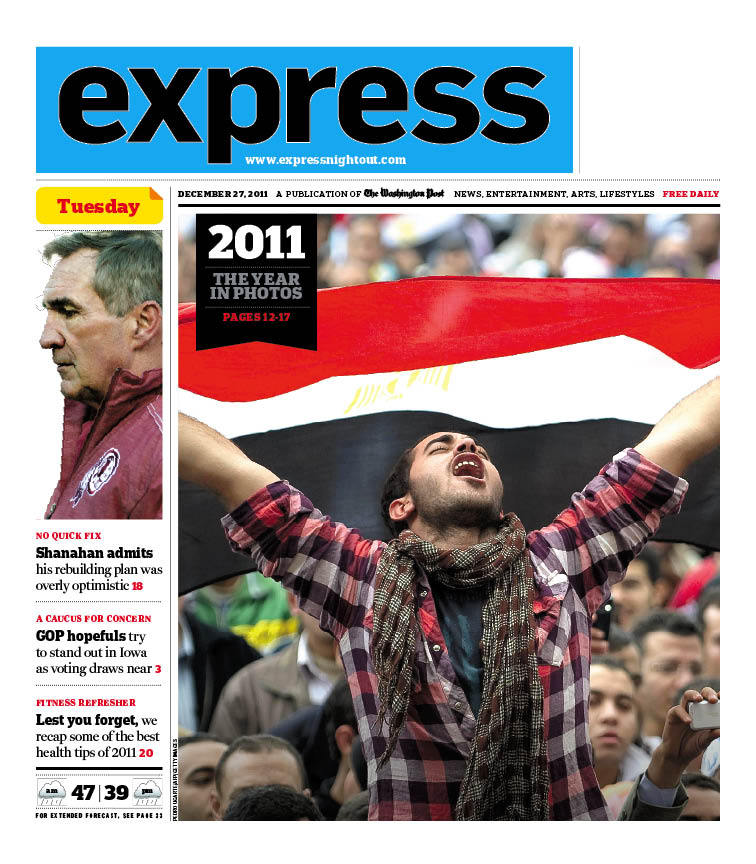
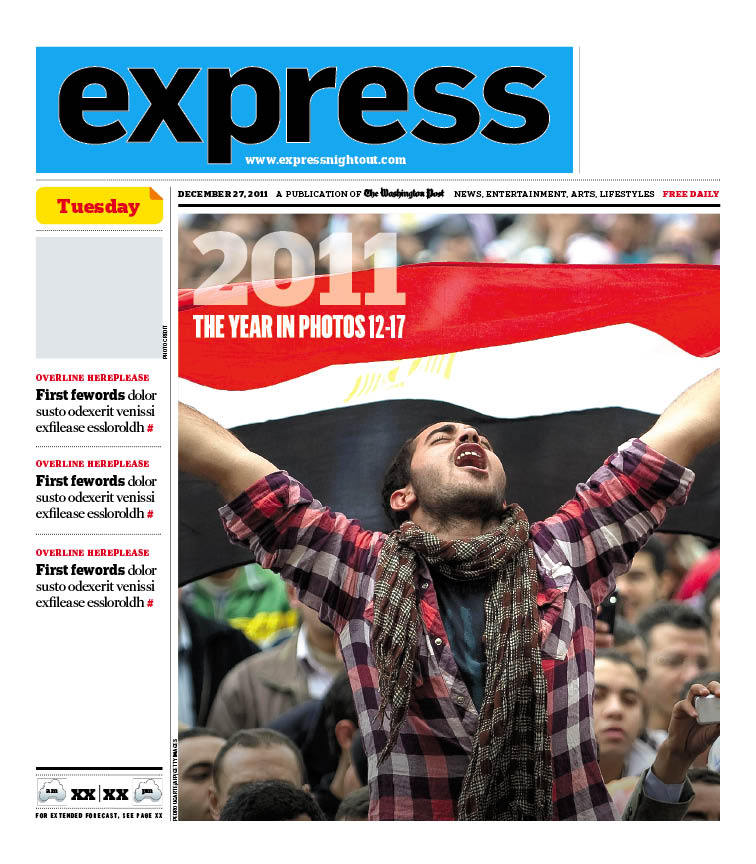
We knew we wanted it to be the Arab Spring protests,

Today's cover

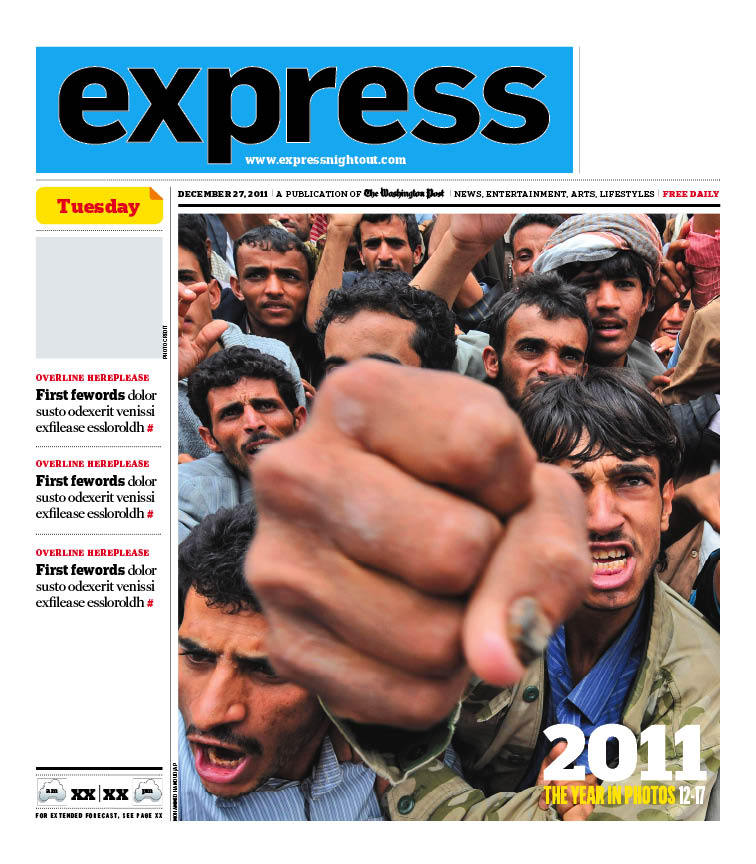
Reject #1

Reject #2

Reject #3

expressafterdeadline:

About today’s cover: “2011: The Year in Photos” We knew we wanted it to be the Arab Spring protests, but were at a loss as to what the quintessential image was. (Up top is the winner: below are the three rejects. Click here to see today’s paper in full.) We needed something relatively simple for our magazine-esque front page, so the giant Tahrir Square crowd photos were out. We proceeded to dismiss the bulk of dozens (hundreds?) of photos we flipped through until landing on these three. I felt like the guy in the middle looked distractingly jolly (like he could easily be twirling pizza dough instead of a flag). Then it was down to joy in Egypt or anger in Yemen. Egypt won out. — Lori Kelley, Express art director

Think my paper made the right choice today? — Ernie @ SFB

Posted by ShortFormBlog • Permalink

Dec 16 2011t

Let’s hope that

nationalpost:

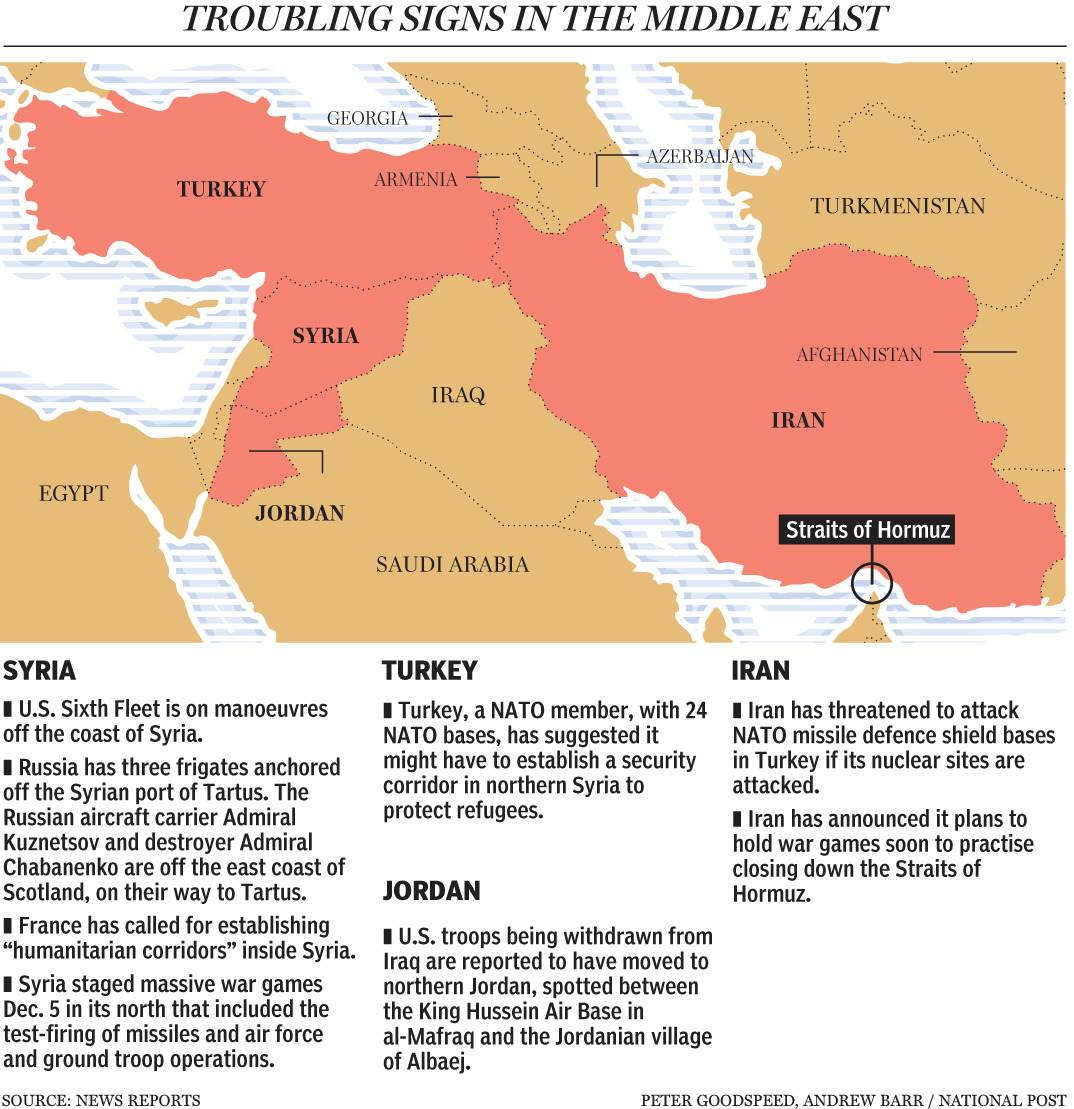
Middle East on the brink of war: analysis
As Syrian dictator Bashar al-Assad clings to power with the quiet backing of regional powers Iran and Russia, the Middle East may be sliding slowly into war.

Squeezed between the rebellions of a bloody Arab Spring and growing fears of a possible military response to Iran’s growing nuclear threat, the region is becoming increasingly unstable.

“I would be very surprised if it turned into a Russian-American war, but this could be a Mid-East war: Hezbollah, Hamas, Iran, Syria, Israel all having at each other,” said Jack Granatstein, military historian and senior research fellow at the Canadian Defence and Foreign Affairs Institute.

Let’s hope that the region doesn’t get any more volatile than it already is. Do you think this analysis is spot-on?

Posted by ShortFormBlog • Permalink

Nov 15 2011W

World: Lebanese politicians get physically violent on live TV

  • Getting touchy: Remember when Mitt Romney touched Rick Perry's shoulder during a GOP debate a while back, and everybody freaked out? Yeah, that was nothing. During a televised debate about Syria yesterday, two Lebanese politicians became enraged and started throwing things at each other. After one guy chucks what looks like a glass of water across the table, the other guy stands up, grabs his chair, and almost hits his foe with it before the host intervenes. The topic of debate was Syrian President Bashar al-Assad, a very polarizing figure in Lebanon. American debates can get heated, but we'd be awfully shocked to see Newt Gingrich chuck his podium at Jon Huntsman while discussing Chinese economic policy. source

Posted by Seth Millstein • Permalink

Oct 30 2011W

World: Bashar al-Assad: Western intervention in Syria "will burn the whole region"

Any problem in Syria will burn the whole region. If the plan is to divide Syria, that is to divide the whole region.

Syrian President Bashar al-Assad • Discussing the situation in Syria, and in the process discouraging Western intervention in the region. While admitting that he expected pressure from the West, he tried in the process to paint a line between his country and other Arab Spring countries. "Syria is different in every respect from Egypt, Tunisia, Yemen. The history is different. The politics is different," he noted. Think he's right? source

Posted by Ernie Smith • Permalink

Oct 26 2011t

The Russian government is not happy with how NATO and the Libyan rebels went about bringing down Gaddafi.

In short, Russia’s foreign minister feels that NATO violated its mandate in attacking Gaddafi’s convoy from the air as he escaped. It also contends that the rebels violated the Geneva convention by killing Gaddafi as they did.

Posted by ShortFormBlog • Permalink

Oct 23 2011W

World: Not like Ben Ali's rule: Tunisian elections draw massive crowds

  • then Elections during the rule of Zine al-Abidine Ben Ali generally drew a fairly small number of people, due to the fact that many believed that the results were pre-determined.
  • now Ten months after the end of Ben Ali's regime, today's elections have drawn huge numbers of people, with lines spreading far beyond the polling booths. source
  • » Not without some controversy: A notable Islamist figure in the country, Rachid Ghannouchi, was heckled as he came out of the voting booth today. "You are a terrorist and an assassin! Go back to London," one shouted. Ghannouchi, the leader of the moderate Ennahda party, spent over two decades in Britain, exiled from the country where he was once imprisoned for his political views. He returned earlier this year, and his party is expected to do well today.

Posted by Ernie Smith • Permalink

Oct 22 2011W

World: Arab Spring: Islamists expected to win big in Tunisian election

Now I am happy that my son's death has given the chance to get beyond fear and injustice. I'm an optimist, I wish success for my country.

Manoubia Bouazizi, mother of notable Tunisian self-immolator Mohamed Bouazizi • Discussing her son's death and the spark for democracy it provided both in her own country but throughout northern Africa and the Middle East. Tomorrow Tunisia holds its first democratic election after the toppling of Zine al-Abidine Ben Ali ten months ago. (Ben Ali is now in exile in Saudi Arabia.) The Islamist Ennahda party, banned while Ben Ali was in power, is expected to garner the most votes, but not without controversy due to the long-encouraged secular culture in the country. It'll be interesting to see what happens next. source

Posted by Ernie Smith • Permalink

Oct 11 2011W

World: Twitter trolls try to control the conversation on Bahrain

They start working and finish all together. Which means, it’s like a job. They talk about Iran, sectarian warfare — they use common words and they never discuss. They just come to fight.

London-based Bahrain blogger Hussain Yousif • Describing the trolls that have come up on Twitter around Bahrain-related topics; trolls which seem to work on a 9-5 schedule. We've noticed a bit of signal-jamming in our day as well — there were a lot of pro-Libya protesters on both Twitter and YouTube who tried to cloud the information actually coming out about Libya, for example — so we totally believe this. Have you guys, especially the ones closely following the news in the Middle East, run into anything like this? source

Posted by Ernie Smith • Permalink

Oct 4 2011t

Turkey to carry out "lightning bolt" exercises along the Syrian border

When a military performs exercises along the border of a neighboring country, it’s often interpreted as a chest-beating projection of nationalist might; this is especially true when the exercise in question is called “lighting bolt.” The goal is to improve coordination between military and civilian forces during wartime which, while not the most overtly threatening action, still serves as a reminder of the country’s military potency. Relations between the two countries have been steadily deteriorating; last week, The Guardian reported that Turkey will respond to Syria’s violent crackdown on protesters with sanctions, a move that France, Germany, Portugal and Britain all opted against.

Posted by ShortFormBlog • Permalink