Read a little. Learn a lot. • Now Mullenweg-free! • Since 2009
☰

Tag: privacy

126 posts

Sep 30 2013t

“Why isn’t there a public outcry by the American people against a government which betrayed them? How can…

Why isn’t there a public outcry by the American people against a government which betrayed them? How can they live with their lives being infiltrated and spied upon by an agency caught in it’s own lies? Why aren’t the members of Government and the NSA involved being sued for privacy issue and data infringement along with international espionage plus the trafficking of data involving matters of national security to another sovereign nation. The Agency breaks international laws and breaks all code of ethics yet still they are able to justify it. This just shows how weak the American people really are standing by while their government takes away their civil rights and all meaning from the amendments.

— A commenter says on The Guardian’s new NSA/Snowden revelation hub.

Posted by Patrick deHahn • Permalink

Sep 29 2013t

NSA gathers data on social connections of U.S. citizens

Since 2010 the National Security Agency has been exploiting its huge collections of data to create sophisticated graphs of some Americans’ social connections that can identify their associates, their locations at certain times, their traveling companions and other personal information, according to newly disclosed documents and interviews with officials. The agency was authorized to conduct “large-scale graph analysis on very large sets of communications metadata without having to check foreignness” of every e-mail address, phone number or other identifier, the document said. Because of concerns about infringing on the privacy of American citizens, the computer analysis of such data had previously been permitted only for foreigners.

The agency can augment the communications data with material from public, commercial and other sources, including bank codes, insurance information, Facebook profiles, passenger manifests, voter registration rolls and GPS location information, as well as property records and unspecified tax data, according to the documents. They do not indicate any restrictions on the use of such “enrichment” data, and several former senior Obama administration officials said the agency drew on it for both Americans and foreigners.

This is merely old information, rehashed with new and official information through more revelations reported by the NYTimes. It’s essentially to wake people up - we all use social networks - and to show how the government and the NSA collects our information that we share on social media, creating extensive maps and graphs.

Posted by Patrick deHahn • Permalink

Aug 16 2013t

Edward Snowden’s latest leak,

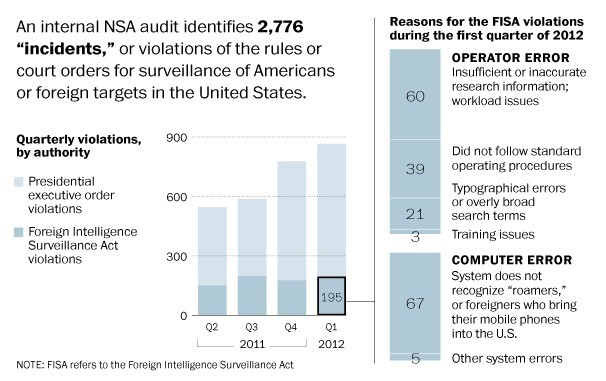
Edward Snowden’s latest leak, which shows (via top-secret documents) that the NSA violated its legal authority on privacy issues thousands of times over the last few years, should really grind your gears. As The New Republic’s Marc Tracy puts it, “There is a valuable, vital debate to be had over how much the federal government, in its intelligence programs, ought to be permitted to violate Americans’ privacy in an effort to protect Americans from a dangerous world that includes people who want to kill Americans.”

Big deal. Catch up.

Posted by Ernie Smith • Permalink

Aug 10 2013t

According to figures published by a major tech provider, the Internet carries 1,826 Petabytes of information…

According to figures published by a major tech provider, the Internet carries 1,826 Petabytes of information per day. In its foreign intelligence mission, NSA touches about 1.6% of that. However, of the 1.6% of the data, only 0.025% is actually selected for review. The net effect is that NSA analysts look at 0.00004% of the world’s traffic in conducting their mission—that’s less than one part in a million. Put another way, if a standard basketball court represented the global communications environment, NSA’s total collection would be represented by an area smaller than a dime on that basketball court.

— A line culled from a document by the NSA, justifying the scale of their collection programs. The document was one of two released by an Obama administration in an attempt to allay fears about the programs. Suffice it to say, the evidence isn’t super-convincing. Regarding the full document, Techdirt’s Mike Masnick writes this simple-but-effective phrase: "This is guffaw inducing.“

Posted by Ernie Smith • Permalink

Aug 8 2013t

This experience has taught me one very important lesson: without congressional action or a strong judicial…

This experience has taught me one very important lesson: without congressional action or a strong judicial precedent, I would strongly recommend against anyone trusting their private data to a company with physical ties to the United States.

— Lavabit owner and operator Ladar Levison • Discussing his decision to shut down his product, which he said came down to this decision: “[To] become complicit in crimes against the American people or walk away from nearly ten years of hard work by shutting down Lavabit.” Sound a little cryptic? There’s a reason. It’s rumored Lavabit was Snowden’s email provider, and that the company lost a recent federal case regarding Snowden.

Posted by Ernie Smith • Permalink

Jul 18 2013t

NSA warned to rein in surveillance as agency reveals even greater scope

The National Security Agency revealed to an angry congressional panel on Wednesday that its analysis of phone records and online behavior goes exponentially beyond what it had previously disclosed.

John C Inglis, the deputy director of the surveillance agency, told a member of the House judiciary committee that NSA analysts can perform “a second or third hop query” through its collections of telephone data and internet records in order to find connections to terrorist organizations.

“Hops” refers to a technical term indicating connections between people. A three-hop query means that the NSA can look at data not only from a suspected terrorist, but from everyone that suspect communicated with, and then from everyone those people communicated with, and then from everyone all of those people communicated with.

Well this just gets better by the day…

Posted by Scott Craft • Permalink

Jun 9 2013t

Boundless Informant, the NSA's secret tool to track global surveillance data

patrickdehahn:

Yes, more from The Guaridan’s Glenn Greenwald:

Revealed: The NSA’s powerful tool for cataloguing global surveillance data, including figures on US collection. Boundless Informant, a mission outlined in four slides and read the NSA’s frequently asked questions document The leaks continue. The United States’ global war also has gone cyber, as revealed in The Guardian’s latest piece on the NSA’s program called Boundless Informant. It categorizes “the voluminous amount” of online and telephone information they receive from each country in the world.

Incremental isn’t the word for these stories. More like flood.

Posted by ShortFormBlog • Permalink

Jun 9 2013t

Allowing the United States government to intimidate its people with threats of retaliation for revealing…

Allowing the United States government to intimidate its people with threats of retaliation for revealing wrongdoing is contrary to the public interest.

— Admitted NSA whistleblower Edward Snowden • In an interview with The Washington Post, the other publication he worked with when leaking information. (He previously spoke to The Guardian.) Snowden says he has no plans to hide from the federal government, and will remain in Hong Kong for the time being. He suggests that, by arresting him, the federal government will only prove his point on the leaks issue. “I’m not going to hide,“ he told the newspaper.

Posted by Ernie Smith • Permalink

Jun 6 2013t

Within the last few years, this program was used to stop a terrorist attack in the United States. We know…

Within the last few years, this program was used to stop a terrorist attack in the United States. We know that. It’s important. It fills in a little seam that we have, and it’s used to make sure that there is not an international [nexus] to any terrorism event if there may be one ongoing. So in that regard, it is a very valuable thing.

— Rep. Mike Rogers, House Intelligence Committee Chairman • Defending a recently revealed NSA program, which collected tens of millions phone records from Verizon, during a press conference on Thursday afternoon. Rep. Rogers claimed that the extremely unpopular program has already prevented at least one act of terrorism, but declined to divulge any additional details, saying such information is still in the process of being declassified. source

Posted by Scott Craft • Permalink