Historically, the police in the United States have employed a standard response when confronted with armed suspects in schools, malls, banks, post offices, and other heavily populated buildings. The first officers to arrive never rushed in. Instead they set up perimeters and controlled the scene. They tried to contain the suspects, and called in a rigorously trained Special Weapons and Tactics (SWAT) team. The SWAT team arrived, assumed positions to keep the suspects pinned down, and negotiated with them until they surrendered. SWAT teams stormed buildings only when necessary to save lives, such as when hostages were being executed one by one.
Today, however, police officers are setting aside traditional tactics. They are being taught to enter a building if they are the first to arrive at the scene, to chase the gunman, and to kill or disable him as quickly as possible. This sweeping change in police tactics–variously called rapid-response, emergency-response, or first-responder–is a direct result of the shootings that occurred at Columbine High School, in Littleton, Colorado, on April 20 of last year, which was the worst in a series of shootings in schools across the United States in the 1990s.
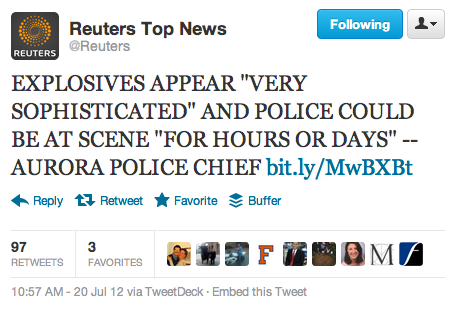
You have to wonder how much this has held up since then, and how much this sort of training helped tonight. (ht pbump)
 ShortFormBlog